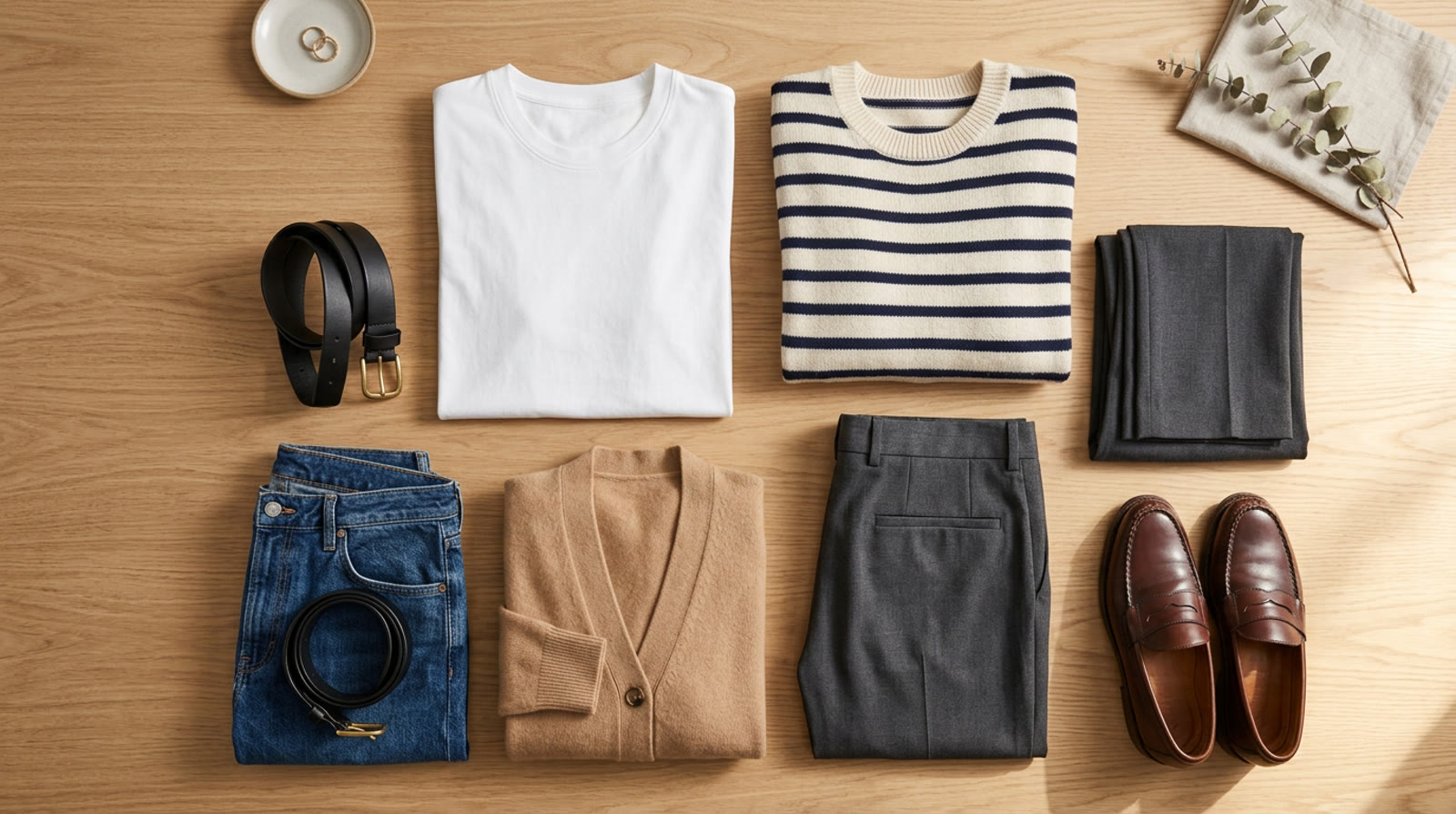
Capsule Wardrobe Staples: The Pieces That Make the System Work
Capsule wardrobe staples are the pieces that earn repeat use because they solve real dressing jobs. They are not just “basic clothes.” A staple might be the tee you reach for because it layers well, the trouser that works with several tops, the cardigan that rescues temperatures, or the shoe that keeps your whole week moving. The idea is less about a fixed shopping list and more about reliable roles inside a closet that needs to work.
If you want the wider system behind the concept, Capsule Wardrobe Systems for Women Who Want Repeatable Outfits explains how staples fit into the full wardrobe structure. This page stays focused on the pieces themselves and how to choose them.
Quick answer
A capsule wardrobe staple is a piece that helps many outfits work together, fits your actual life, and earns its space by being worn often. Staples are not the same for everyone because lifestyle, climate, dress code, laundry routine, and comfort needs change what “useful” means.
A staple can be neutral or colorful, simple or slightly special, but it should do a clear job: help your wardrobe mix, match, layer, move, or finish outfits more easily.
What capsule wardrobe staples are and are not
A staple is a role, not a rule. It is the kind of piece that keeps showing up because it keeps solving problems. In that sense, staples are less about a perfect wardrobe image and more about repeatable usefulness.
Capsule wardrobe staples are:
- pieces you can wear in more than one outfit
- pieces that fit your climate and routine
- pieces that make other clothes easier to use
- pieces that can be repeated without feeling wasted
Capsule wardrobe staples are not:
- a universal shopping list for every reader
- the same as a closet full of basics
- automatically neutral or boring
- identical across work, home, travel, or school routines
If you want the full system view, What Is a Capsule Wardrobe? A Simple Definition and How It Works explains the wardrobe concept itself. This page is the layer below that: the actual building blocks that support the system.
Staple categories and the role each one plays
The easiest way to understand staples is by role. Different categories earn their place in different ways, and no single category has to be heavy with items if your life does not need it.
| Category | What the role does | What makes it useful |
|---|---|---|
| Tops | Start most outfit combinations and sit closest to the body | Works with multiple bottoms, layers cleanly, and feels comfortable across a normal week |
| Bottoms | Anchor the silhouette and carry the outfit’s level of polish or ease | Pairs with several tops, fits well, and matches how you actually move |
| Layers | Adjust temperature and add structure or softness | Makes outfits work across weather, rooms, and repeated wear |
| Dresses / one-piece options | Create a complete outfit with less decision-making | Easy to style with shoes, layers, or accessories for different settings |
| Shoes | Shift the outfit’s function and comfort level | Works for the walking, standing, or dressing-up demands of your routine |
| Outerwear | Solves weather and finish the outfit visually | Fits the climate, layers over your clothes, and feels right for your day |
| Bags / accessories | Carry what you need and change the mood of the outfit | Useful, durable, and able to support more than one look |
Tops and bottoms usually get the most attention, but they are only part of the system. A capsule wardrobe can fail if the shoes are wrong for your life or the outerwear does not match your climate. A piece earns staple status because it helps the whole outfit work, not because it is fashionable in isolation.
How to choose staples based on your real life
Staples should reflect the life you actually live. That means the right pieces will look different depending on the day-to-day demands around you.
Lifestyle
Your staples should match the activities that fill your week. Someone who commutes, sits in meetings, and walks between offices may need different staple roles than someone who works from home, does school pickup, or spends long days on their feet.
The question is not “What is a staple in general?” It is “What gets worn repeatedly in my life without becoming annoying?”
Climate
Climate changes staple value fast. A piece that works beautifully in mild weather may be useless in heat, rain, or heavy layering season. In a warmer climate, breathable tops and lighter outerwear may matter more. In a colder climate, layers and outerwear may carry more of the outfit’s burden.
Dress code
Dress code changes the level of polish your staples need to provide. A staple for a casual closet may be relaxed and easygoing, while a staple for a more polished setting may need cleaner lines, better structure, or more versatile shoes.
If your weekly life crosses more than one dress code, you may need staples that bridge those settings rather than pieces that only work in one narrow context.
Laundry routine
Laundry affects how many pieces you really need in a role. If you wash weekly and wear certain items almost every day, you may need enough rotation to keep the closet usable. If you do laundry more often, you may need fewer duplicates and more highly flexible pieces instead.
Laundry is part of wardrobe design. It is not a side note.
Comfort
A piece that looks right but feels wrong will stop behaving like a staple. Comfort includes fabric feel, waistband shape, shoe support, sleeve length, ease of movement, and how much mental energy a piece takes to wear.
A closet can look coherent and still fail if the staples are uncomfortable in real life.
A beginner-friendly starter staple framework
A beginner does not need to build a perfect capsule from day one. A better starting point is to think in roles and coverage.
Here is a simple framework you can use as a starting map:
- 1–2 tops that work across most of your week
- 1–2 bottoms that match those tops and suit your routine
- 1–2 layers that solve temperature or polish needs
- 0–2 one-piece options if you actually wear dresses or jumpsuits
- 1–2 pairs of shoes that cover your main movement and dress-code needs
- 1 outerwear piece for the season you are in
- 1–2 bags or accessories that support function and finish the outfit
That is a framework, not a law. If dresses are not part of your real life, that role can stay minimal. If you work in a setting that needs more polish, your “top” role may need a more structured option. If you mostly wear one kind of shoe, then the shoe role becomes especially important.
The goal is coverage, not collection building.
How staples support outfit formulas and weekly planning
Staples make outfit formulas easier because formulas depend on pieces that can swap in and out without breaking the outfit’s structure. If What Is an Outfit Formula? A Simple Definition and How It Works is the pattern, staples are the pieces that let the pattern repeat in a way that feels fresh instead of flimsy.
For example, a formula like top + bottom + layer + shoes only works well if each slot has a piece that actually belongs there. A top that wrinkles immediately, a bottom that only matches one shirt, or a shoe that ruins your comfort will make the formula harder to use.
Staples also support weekly planning because they reduce the number of unknowns. When the core pieces are reliable, Weekly Outfit Planner for Busy Women becomes much easier to use. You can map outfits around the pieces you already trust instead of trying to invent a new system every morning.
If you want the role-specific versions of this idea, Work Capsule Wardrobe: A Practical System for Getting Dressed Faster and Teacher Capsule Wardrobe: Comfortable, Professional, Repeatable show how the staple mix changes when the setting changes. For the formula layer that uses those staples, Work Outfit Formulas: Repeatable Office Looks for Busy Workdays and Teacher Outfit Formulas: Easy Classroom Looks for Real School Days show how repeatable outfit patterns become practical in those contexts.
What makes a staple weak or not worth keeping
A weak staple is not just an item you do not like. It is a piece that does not earn its space because it does not do enough useful work.
Weak staple signs:
- it only works with one outfit
- it needs constant fixing, adjusting, or replacing
- it is uncomfortable enough that you avoid it
- it duplicates a role already covered by a better piece
- it does not fit your climate, dress code, or routine
- it looks good in theory but fails in practice
Strong staple signs:
- it repeats across many outfits
- it is comfortable enough to wear without hesitation
- it suits the life you actually live
- it supports more than one season or context
- it is easy to style with the rest of your wardrobe
- it survives regular wear without becoming high-maintenance
This is where many wardrobes get stuck. People keep pieces because they feel like “classic” items, not because they are genuinely useful. A staple should earn its place by improving the whole closet.
Staples for work, teaching, and other real-life contexts
The same category can play a different role depending on the setting. A work staple may need sharper lines or more polish. A teacher staple may need more movement, comfort, or layers that make temperature changes easier. A casual staple may be simpler and more relaxed.
That is why the best staples are role-first rather than trend-first. The item itself is less important than what job it performs in your wardrobe.
If you want examples of how those roles shift in practice, Work Capsule Wardrobe: A Practical System for Getting Dressed Faster and Teacher Capsule Wardrobe: Comfortable, Professional, Repeatable are the best next pages. If you want to see how those staples become repeatable looks, Work Outfit Formulas: Repeatable Office Looks for Busy Workdays and Teacher Outfit Formulas: Easy Classroom Looks for Real School Days take the next step.
Common mistakes
A few mistakes can make staple thinking less useful than it should be:
- treating staples like a universal checklist instead of a personal system
- buying only “basics” and forgetting about function, climate, or comfort
- collecting too many similar pieces that all do the same job
- ignoring shoes, outerwear, and bags because they feel less glamorous
- using staples as a way to avoid choosing clothes that fit your real life
- confusing “popular” with “essential”
If you are trying to audit your closet piece by piece, Capsule Wardrobe Checklist: Build a Closet That Mixes and Matches is the better next step. If you want to turn the pieces you keep into a weekly rhythm, Weekly Outfit Planner for Busy Women will help you build that routine.
FAQ
What is a wardrobe staple?
A wardrobe staple is a piece you wear repeatedly because it serves a clear job in your closet. In a capsule wardrobe, the job matters more than the label.
How many staples do I need?
There is no single number. The right number depends on your lifestyle, laundry routine, climate, and how often you need each role to repeat.
Do staples have to be neutral?
No. Neutral pieces can be helpful, but a staple is defined by usefulness, not by color alone. If a color or print works across many outfits in your life, it can still be a staple.
What makes a piece versatile enough to count as a staple?
A versatile staple works in multiple outfits, matches your routine, and can be repeated without becoming a problem to wear.
Is a staple the same thing as a basic?
Not exactly. A basic is usually a simple item. A staple is an item that has proven it earns repeat use in your real wardrobe.
Conclusion
Capsule wardrobe staples are the pieces that keep the system usable. They are not a generic shopping list, and they are not identical for every reader. They are the role-based pieces that help your clothes work together in your actual life.
Your next step is simple: pick one role you rely on most — tops, bottoms, layers, shoes, or outerwear — and test whether the pieces you own are truly earning their place. If you want the broader system behind that decision, go back to Capsule Wardrobe Systems for Women Who Want Repeatable Outfits. If you want the item-by-item audit layer, move next to Capsule Wardrobe Checklist: Build a Closet That Mixes and Matches.