
Teacher Capsule Wardrobe: Comfortable, Professional, Repeatable
A teacher capsule wardrobe is not about looking perfect in a classroom mirror. It is about getting dressed for real school days without fighting your clothes all day.
That means the wardrobe has to handle movement, long standing hours, temperature swings, modesty expectations, and the small details that matter when you are walking the halls, bending over student desks, carrying supplies, or moving from a warm classroom to a cold hallway and back again.
The best teacher capsule wardrobe is the one that makes those school-day realities easier. It gives you a small set of compatible pieces, repeatable outfit logic, and enough flexibility to stay polished without building every morning from scratch.
The Teacher Wardrobe Loop
A simple teacher wardrobe loop keeps the system practical:
- Comfort — start with pieces that feel good through a full school day.
- Coverage — make sure the outfit works for classroom movement and modesty needs.
- Polish — keep the result neat, professional, and school-appropriate.
- Repeatability — make sure the outfit can be worn again in a different combination next week.
That loop is what turns a closet into a working teacher wardrobe instead of a random collection of clothes.
What a teacher capsule wardrobe is
A teacher capsule wardrobe is a focused clothing system built for classroom life. It is usually more practical than a generic work wardrobe because teachers need outfits that can handle a full day of movement, supervision, and constant small transitions.
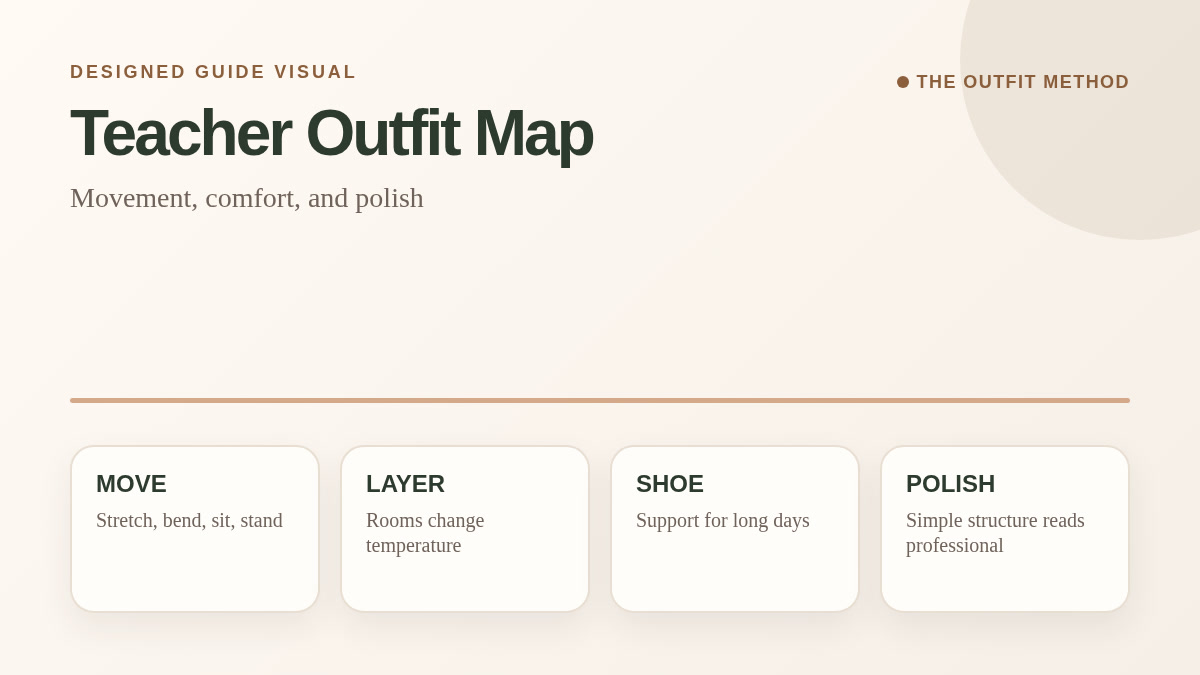
The goal is not a huge closet. The goal is a reliable one.
A good teacher capsule wardrobe helps you:
- dress quickly on busy school mornings
- stay comfortable through long standing periods
- maintain a polished, professional look
- move easily while teaching, reaching, bending, and walking
- repeat outfits without looking unplanned
- keep dressing decisions simple across the school week
How it differs from a work capsule wardrobe
A teacher capsule wardrobe and a work capsule wardrobe overlap, but they are not the same thing.
| Teacher capsule wardrobe | Work capsule wardrobe |
|---|---|
| Built around classroom movement and supervision | Built around office or workplace polish |
| Must handle standing, walking, bending, and floor-level work | Often assumes more sitting and desk-based work |
| Often needs stronger coverage and practical layers | Often has more flexibility in silhouette and styling |
| Must account for classroom temperature swings | Must account for office temperature and commute needs |
| Often needs pockets, bags, and hands-free practicality | More likely to center office-ready structure |
If the dress code language at your school feels confusing, a clearer comparison like Business Casual vs Smart Casual: What’s the Difference? can help you set the right level of polish. After that, this page helps you build the actual system.
Classroom realities that should shape the wardrobe
Classroom movement
Teachers need clothes that move with them. Reaching for a whiteboard marker, crouching beside a desk, carrying books, or moving between stations should not cause constant adjusting.
If an outfit twists, rides up, gaps, or pulls every time you move, it is not doing its job.
Long standing hours
Many school days involve more standing than people expect. Hall duty, supervision, classroom instruction, drop-off, pickup, and transitions all add up.
That means comfort cannot be an afterthought. Waistbands, shoe support, and fabric feel all matter more than they would in a wardrobe built for sitting at a desk all day.
Modesty and professionalism
Different schools have different expectations, but many teachers need outfits that feel covered, neat, and dependable.
That may mean paying attention to hemlines, necklines, sleeve length, fabric opacity, or whether a piece stays polished when you move. The capsule should support that level of professionalism without making every outfit complicated.
School temperature changes
Classrooms are often warmer than hallways, and some schools swing between overheated and chilly zones in the same day.
That is why easy layers matter. A good teacher capsule usually works best when the layers are light enough to wear indoors, easy to remove, and simple to put back on without changing the whole outfit.
Fabric, fit, and day-long wear
Teacher clothing has to survive a real day, not just a mirror check.
The best pieces usually do well in a few practical categories:
- washable fabrics
- wrinkle resistance
- opacity
- stretch
- stain tolerance
- breathable layers
- standing and walking comfort
- pockets or bag support
- color and texture that still look clean after a long day
A blouse that looks beautiful but shows everything or wrinkles immediately is a weak teacher piece. A pant that looks polished but cuts into your waist by noon is weak too. The wardrobe only works when the clothes can survive the day you actually live.
Easy layers
The best layers for teachers tend to be the ones that finish an outfit without weighing it down. A soft blazer, a light cardigan, or a simple structured layer can add polish without making movement harder.
Heavy layers can be too warm. Fussy layers can be too slow. The useful ones are the ones you actually reach for on a real Monday morning.
The shoe bridge
Shoes deserve their own support page, but they still affect the capsule system.
A teacher-friendly shoe bridge is the pair that connects comfort and polish well enough to carry you through a school day. It should be stable, walkable, and realistic for the amount of movement your routine demands. If shoes are the weak point in your outfits, Teacher-Friendly Shoes: Comfortable Options That Still Look Polished is the next place to go.
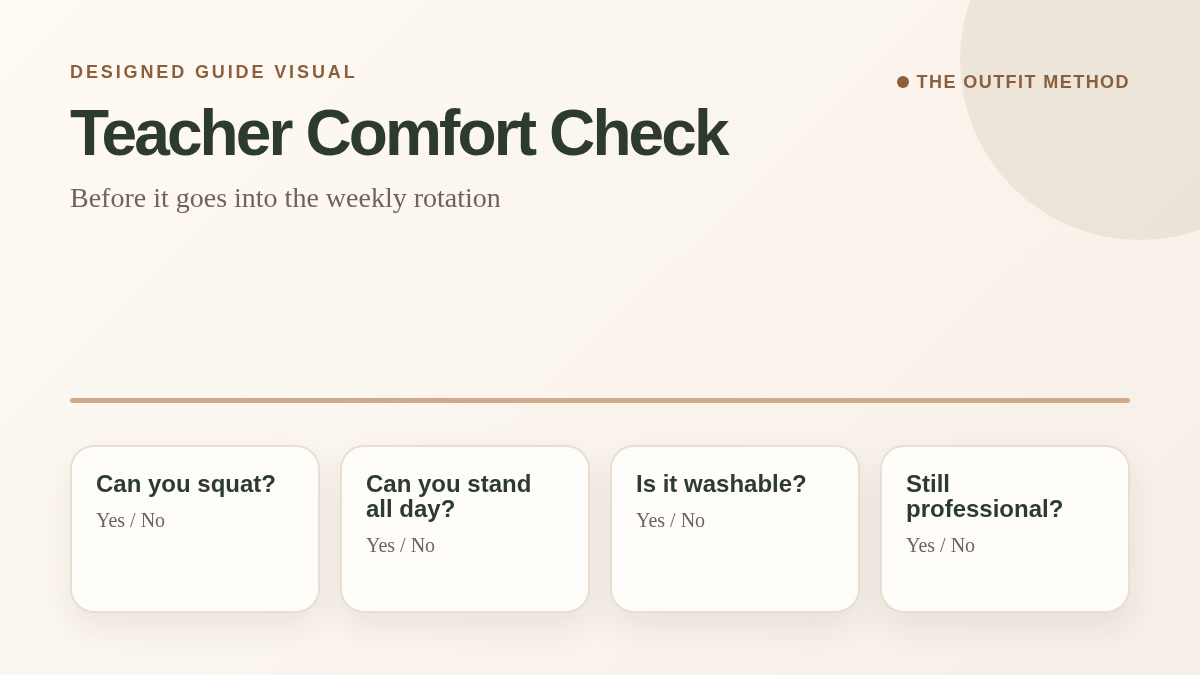
What belongs in a teacher capsule wardrobe
A teacher capsule does not need to be large. It needs to be balanced.
A practical starting point often includes:
- tops that work on their own and under layers
- bottoms that allow movement and still look professional
- one or two easy layers for classroom temperature changes
- shoes that can handle standing and walking
- a bag or accessory system that supports the routine without adding clutter
A practical starter teacher capsule example
Here is one example of a starter teacher capsule with 12 pieces. This is only an example, not a universal rule.
| Category | Pieces |
|---|---|
| Tops | 3 pieces: one polished tee or shell, one blouse, one knit top |
| Bottoms | 3 pieces: one straight pant, one ankle pant, one midi skirt or school-appropriate relaxed trouser |
| Layers | 2 pieces: one cardigan, one soft blazer or structured layer |
| Shoes | 2 pieces: one comfortable flat or loafer, one low-heel or support-first shoe |
| Extras | 2 pieces: one bag, one simple accessory layer such as a belt, scarf, or earrings |
That mix is enough to build multiple school-week outfits without turning the wardrobe into a closet full of single-use items.
Pieces that earn their place
Some pieces actively help a teacher capsule because they solve more than one problem at once.
Examples include:
- washable knit top
- opaque blouse
- easy pant with comfortable stretch
- cardigan that layers without bulk
- soft blazer or structured layer
- stable shoes that can handle standing and walking
- simple bag that carries classroom essentials without getting in the way
- low-maintenance accessories that do not need constant adjusting
These are the kinds of pieces that make the capsule easier to wear, not just easier to own.
Sample school-week rhythm
A teacher capsule should repeat in a way that feels natural, not obvious.
A simple school-week rhythm might look like this:
- Monday: start with the most reliable outfit so the week begins easily
- Tuesday: repeat the base with a different layer or top
- Wednesday: use the most comfortable combination for the busiest day
- Thursday: bring back a favorite piece in a different mix
- Friday: choose the outfit that feels easiest to wear and cleanest to repeat
The point is not to create a new outfit formula every day. The point is to make a few good combinations do most of the work.
That is also why the wardrobe stays distinct from Teacher Outfit Formulas: Easy Classroom Looks for Real School Days. This page is about the system; the formula page is about the combinations.
How to build the system
Start with the outfit you already wear most often to school.
Then ask three questions:
- What part of that outfit actually works well?
- What part creates friction during the day?
- What would make the outfit easier to repeat next week?
Once you know that, you can build the rest of the capsule around the parts that already make sense.
From there, add pieces that support classroom movement, long standing hours, easy layering, and the level of professionalism your school expects. If you want to see how this turns into repeatable outfit combinations, the next step is Teacher Outfit Formulas: Easy Classroom Looks for Real School Days. If you want to tighten the accessories and support pieces, Capsule Wardrobe Staples: The Pieces That Make the System Work and Weekly Outfit Planner for Busy Women can help.
What a strong teacher capsule wardrobe avoids
A strong teacher capsule avoids too many single-use pieces, too many delicate fabrics, and too many outfits that only look good when you are not doing actual classroom work.
It also avoids turning every morning into a dress-code puzzle.
The right wardrobe should make school mornings simpler, not more interesting.
FAQ
What is a teacher capsule wardrobe?
A teacher capsule wardrobe is a small, intentional clothing system built for classroom life. It is designed to be comfortable, professional, repeatable, and practical for real school days.
How is it different from a work capsule wardrobe?
A teacher capsule wardrobe has to handle more movement, more standing, more classroom-specific modesty concerns, and more temperature swings than many office-focused wardrobes.
How many pieces should be in a teacher capsule wardrobe?
There is no single right number, but many teachers can start with a small core and build from there. A 10–15 piece example is often enough to prove the system before it grows.
How many shoes do teachers need?
Most teachers need at least one reliable comfort-first pair and one backup pair that still works for school. The exact number depends on commute, weather, and dress code.
Can a teacher capsule wardrobe be modest?
Yes. Modesty can be built into the capsule through coverage, opacity, layering, length, and fit choices that match the school environment.
What should teachers prioritize first?
Start with comfort, coverage, and the pieces you wear most often. Then build around the outfit that already works and reduce the friction points.
How do I avoid repeating the same outfit too obviously?
Use the same base pieces in different combinations, vary the layer, and rotate the supporting items instead of trying to create a completely new look every day.
What if my school dress code is unclear?
Start by identifying the level of polish your school seems to expect and compare that with a clearer framework like Business Casual vs Smart Casual: What’s the Difference?. Then build your capsule from the safest, most repeatable choices.
Conclusion
If you want to build a teacher capsule wardrobe that actually holds up in real life, start with one outfit you already wear to school and already feel good in.
Then identify:
- what makes that outfit work
- what creates friction in the classroom
- what needs to change so it becomes easier to repeat
Use that as the starting point for the capsule. That way, you are building from reality instead of from theory.
When the system is right, getting dressed for school stops feeling like a daily decision and starts feeling like a routine that supports the day.
Related guide: once the capsule is set, teacher outfit formulas help turn it into school-day outfits, and teacher-friendly shoes keeps the whole wardrobe practical.
Keep these outfit ideas handy.
Save this guide on Pinterest (opens in a new tab)More ideas for your wardrobe
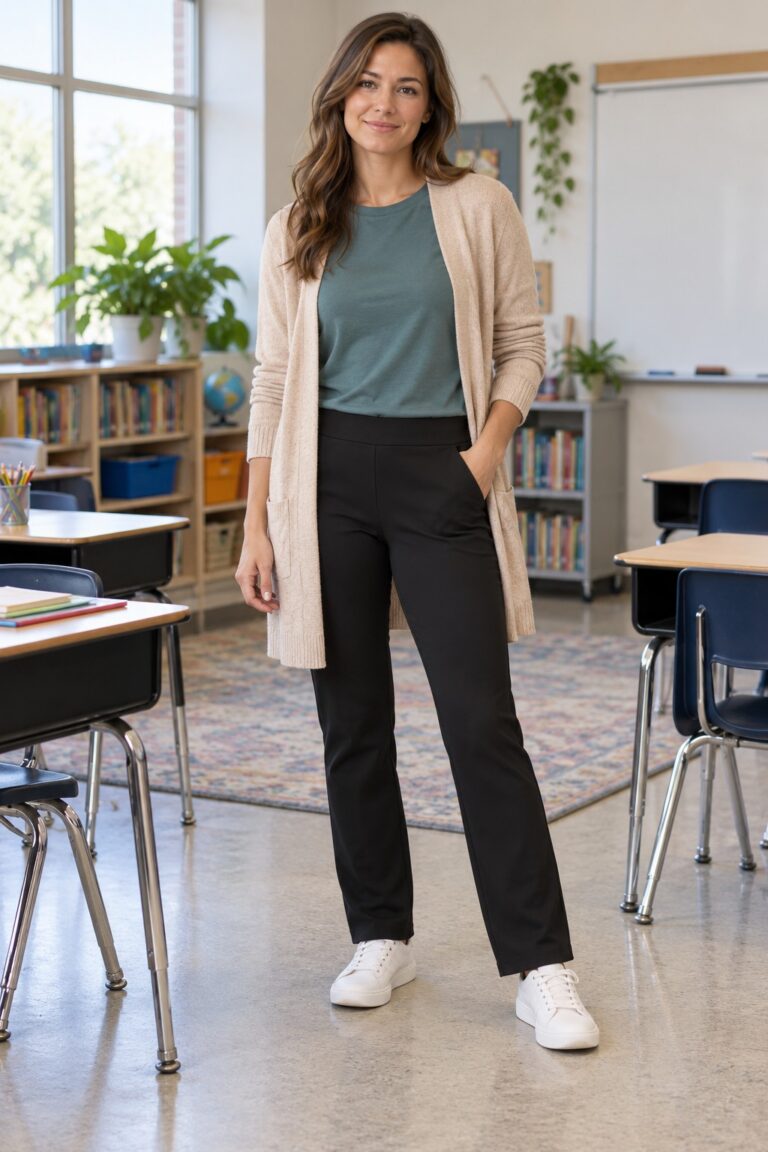 Teacher Outfit Ideas9 Elementary Teacher Outfits for Floor Time and Hallway Duty
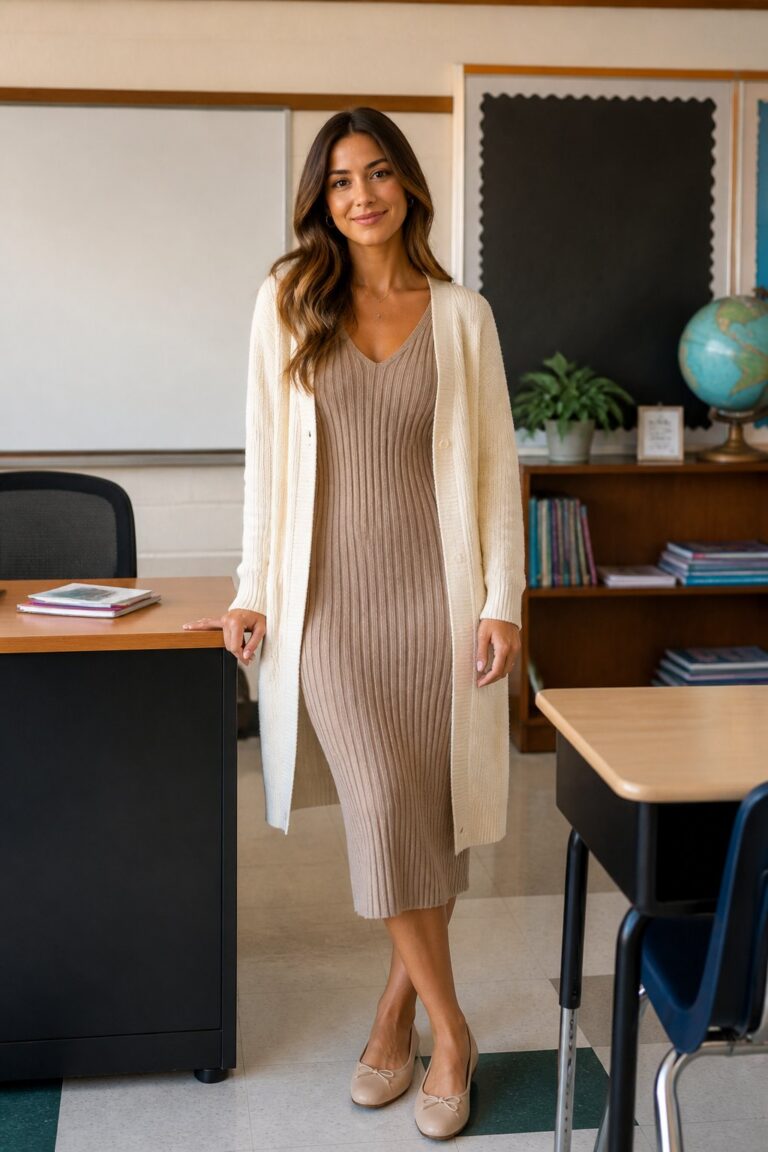 Teacher Outfit IdeasBack-to-school teacher outfits for a fresh first week
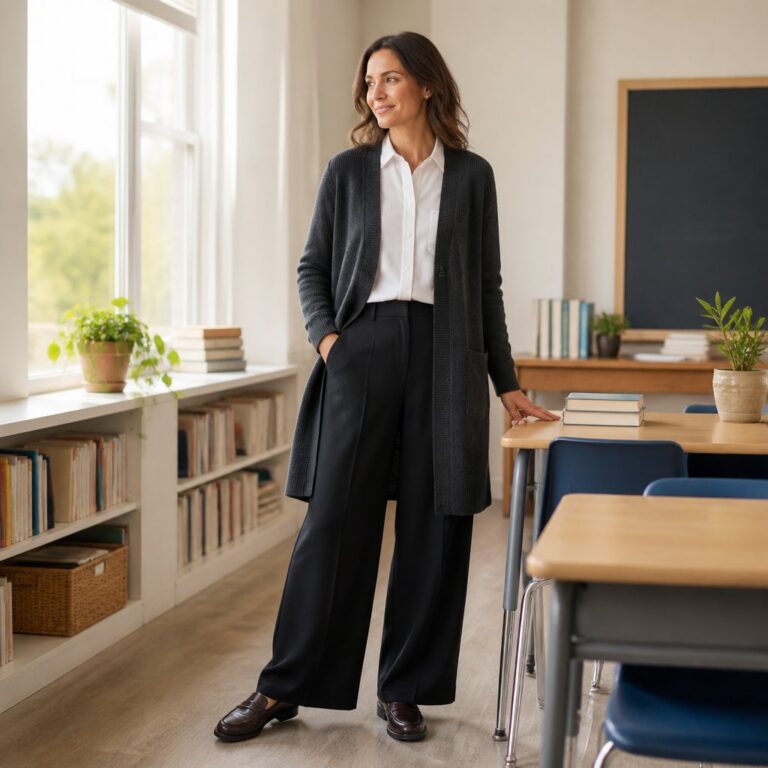 Teacher Outfit IdeasModest Teacher Outfits That Feel Polished, Covered, and Easy to Wear
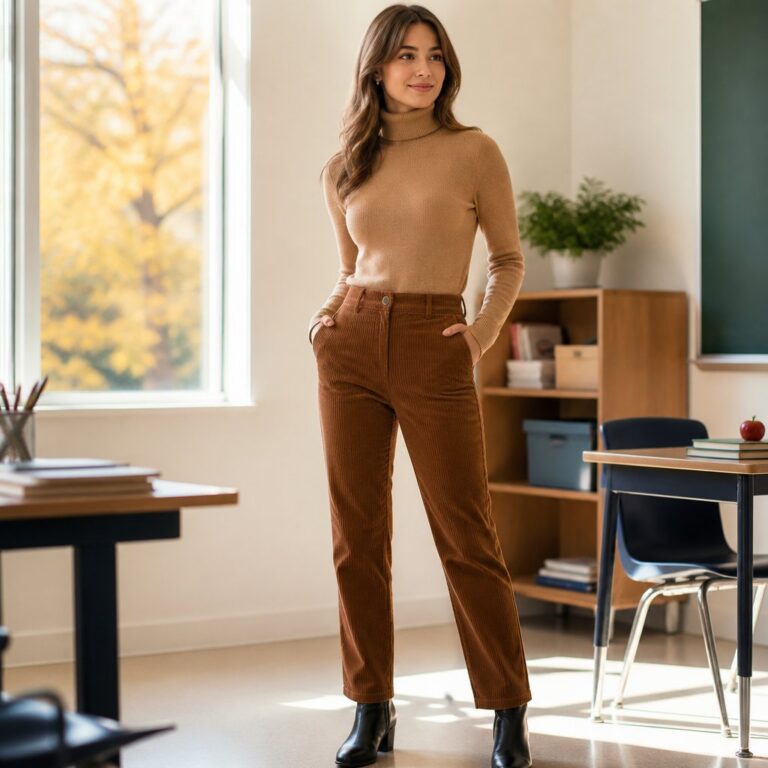 Teacher Outfit IdeasFall Teacher Outfits That Feel Polished, Comfortable, and Classroom-Ready