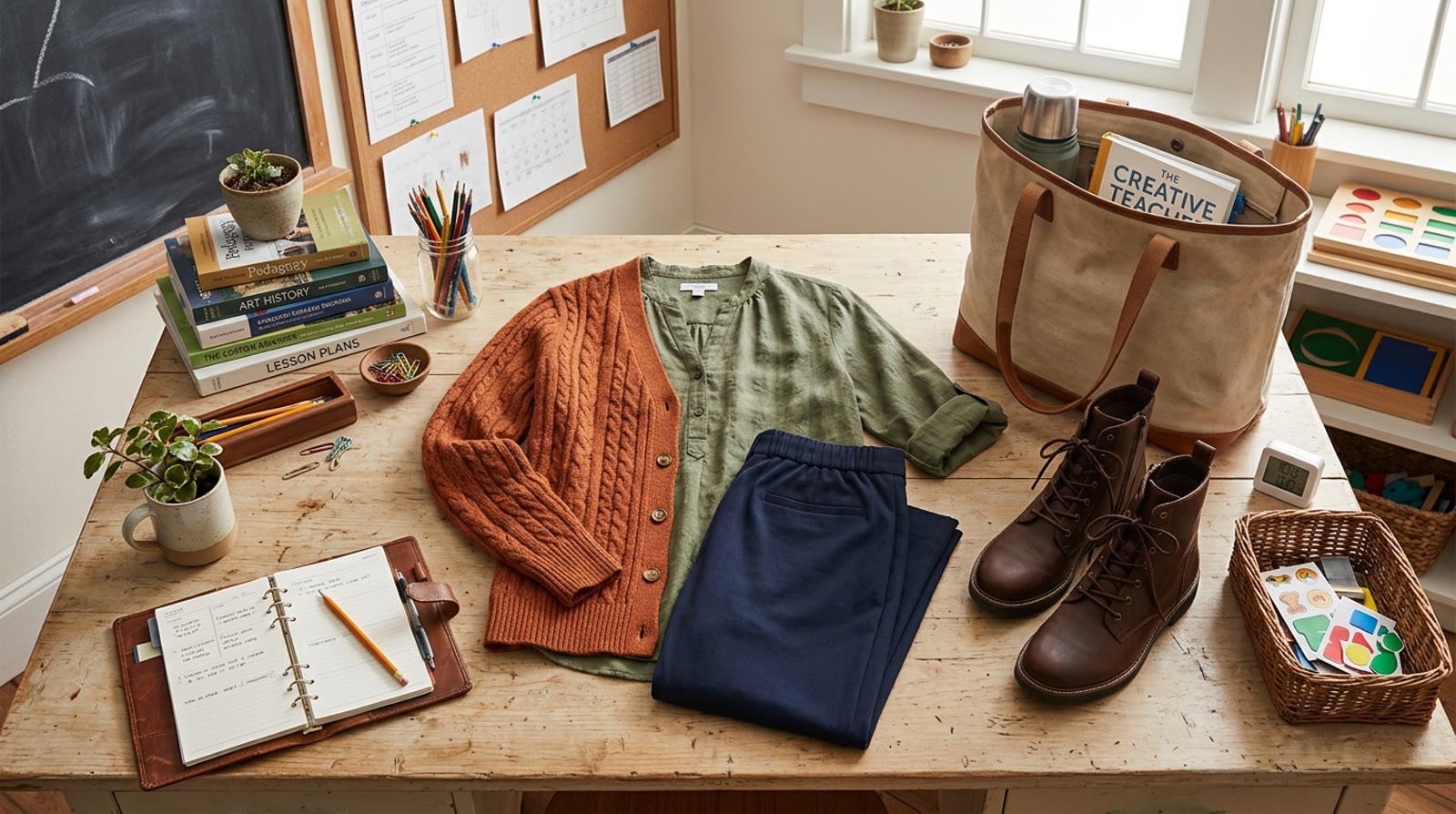
Teacher Outfit Formulas: Easy Classroom Looks for Real School Days
Teacher outfit formulas make getting dressed faster because they remove the guesswork. Instead of starting from scratch every morning, you reuse a small set of repeatable combinations that already work for classroom life.
The key is to keep the formula side of the system separate from the wardrobe side. If you want the full clothing-system logic first, start with Teacher Capsule Wardrobe: Comfortable, Professional, Repeatable. If you want the outfit patterns themselves, this is the page to use.
The Classroom Formula Loop
A simple teacher formula loop keeps outfits practical:
- Base — the top or dress foundation that sets the outfit.
- Support — the bottom, layer, or second piece that makes it classroom-ready.
- Comfort — the part that handles movement, standing, or temperature changes.
- Finish — the shoe or accessory layer that keeps the look polished.
- Repeat — reuse the same structure with a different piece next time.
That loop keeps formulas useful without turning them into a full capsule wardrobe explanation.
How teacher outfit formulas work
A teacher outfit formula is a repeatable outfit pattern you can reuse across the school week.
The best formulas are simple enough to remember and flexible enough to adjust for school temperature, modesty expectations, movement, and shoe comfort.
A good formula should help you:
- get dressed quickly on busy mornings
- stay comfortable through standing and walking
- keep coverage and professionalism in place
- adjust for warm classrooms and cooler hallways
- repeat outfits without feeling like you wore the exact same thing
Each formula should still be adjusted to your school dress code, modesty expectations, and comfort needs.
Formula rules that matter in real school days
Teacher formulas should be built around how school days actually feel, not just how outfits look in a mirror.
That means paying attention to:
- movement: reaching, crouching, sitting low, and walking the halls
- comfort: waistbands, sleeves, and layers that do not fight your body
- modesty: coverage, opacity, and fit that feel school-appropriate
- temperature: classroom heat, hallway cold, and changing indoor conditions
- shoes: support, stability, and enough polish to fit the outfit
The formula page stays distinct from the shoe page by naming shoes as part of the formula, not as the whole topic. If shoes are the friction point you want to solve separately, Teacher-Friendly Shoes: Comfortable Options That Still Look Polished is the next stop.
8 repeatable teacher outfit formulas
These are example formulas, not rules you have to follow exactly.
1. Knit top + straight pant + cardigan + flats
A dependable everyday formula for normal classroom days.
Quick substitutions:
- swap the knit top for a washable blouse
- swap the straight pant for an ankle pant
- swap the cardigan for a soft blazer on dressier days
- swap flats for loafers if you want a slightly more polished finish
Practical note: this formula works well when you need comfort, movement, and easy layering.
2. Blouse + easy pant + soft blazer + stable shoes
A more polished classroom formula for meetings, observation days, or presentation-heavy days.
Quick substitutions:
- swap the blouse for an opaque knit top
- swap the soft blazer for a cardigan if the room is warm
- swap the easy pant for a straight skirt if your school dress code allows it
- swap stable shoes between loafers, flats, or low-support heels
Practical note: choose fabrics that do not wrinkle quickly and keep enough structure to stay neat through the day.
3. Knit dress + cardigan + low-profile shoes
A one-piece formula that makes mornings simple.
Quick substitutions:
- swap the knit dress for a midi dress with structure
- swap the cardigan for a soft blazer
- swap low-profile shoes for a stable flat or block-heel style if you need a little more polish
- add tights or a layer underneath if the classroom is cool
Practical note: this formula is easiest when the dress has enough opacity and stretch to move comfortably.
4. Polished tee or shell + midi skirt + cardigan + flats
A lightweight formula that works well when you want coverage without feeling over-layered.
Quick substitutions:
- swap the polished tee for a blouse
- swap the midi skirt for an easy pant if you need more movement
- swap the cardigan for a blazer when the outfit needs more structure
- swap flats for loafers if you want more stability for walking
Practical note: this formula is useful when the school day involves a lot of movement but you still want a neat, covered look.
5. Structured top + relaxed pant + blazer + comfortable shoe
A formula with a little more ease in the lower half.
Quick substitutions:
- swap the relaxed pant for a straight pant if you want a sharper profile
- swap the structured top for a blouse if the room is chilly
- swap the blazer for a cardigan if the day is more casual
- swap the comfortable shoe for a stable loafer if you want a more polished finish
Practical note: this works well when you want room to move without losing shape.
6. Knit top + skirt + blazer + low-heeled shoe
A formula that can feel polished without being stiff.
Quick substitutions:
- swap the skirt for pants if you want more coverage or movement
- swap the knit top for an opaque blouse if you need a dressier look
- swap the blazer for a cardigan when the room is too warm
- swap the low-heeled shoe for a flat if you walk more than usual
Practical note: use this when your school day has meetings, teaching, and a need for a slightly more polished finish.
7. Dress + jacket + comfortable shoe
A fast formula for mornings when you need one piece to do most of the work.
Quick substitutions:
- swap the dress for a knit dress or structured midi dress
- swap the jacket for a cardigan if you need less weight
- swap the comfortable shoe for a more supportive pair if you will be on your feet longer
- add a layer if the dress is too light for classroom temperature changes
Practical note: choose a dress that still feels covered and manageable when you move around the classroom.
8. Polished top + easy pant + stable shoe + simple accessory
The simplest formula when you want the outfit to disappear into the day but still look intentional.
Quick substitutions:
- swap the polished top between a blouse, knit top, or polished tee
- swap the easy pant between a straight pant or ankle pant
- swap the stable shoe between a loafer, flat, or low-profile support-first pair
- swap the simple accessory between a belt, scarf, low-key jewelry set, or structured bag
Practical note: this formula works because it looks clean, feels manageable, and still supports a long school day.
Seasonal Swaps for Teacher Outfit Formulas
The goal is not to build a seasonal wardrobe guide. It is to keep the same formulas usable when the weather changes.
Warm school days
Use lighter tops, breathable layers, and lower-weight shoes. Swap a blazer for a cardigan or remove the layer entirely if the room runs hot.
Cold classrooms
Add a cardigan, soft blazer, tights, or a base layer under the formula. Keep the silhouette the same and adjust the weight around it.
Rainy days
Choose formulas that still work with weather-proof shoes, a stable bag, and layers that do not get fussy when you move between buildings or parking lots.
Transitional seasons
Use the same formula and change only one element at a time: layer weight, fabric weight, or shoe choice. That keeps the outfit consistent without making it feel repetitive.
How to repeat formulas without looking identical
The point of formula dressing is repetition with variation.
To keep formulas from looking too obvious:
- change one piece, not the whole structure
- rotate the layer instead of rebuilding the outfit
- shift the shoe from flat to loafer or loafer to low heel
- change the fabric texture, not just the color
- use the same formula across different levels of polish
That is why formulas belong on this page, while the broader system belongs on Teacher Capsule Wardrobe: Comfortable, Professional, Repeatable.
Formula substitution logic
When a formula stops working, replace the part that causes friction first.
Ask:
- Is the top too sheer, too hot, or too fussy?
- Is the bottom too restrictive for movement?
- Is the layer too heavy for the classroom?
- Is the shoe too tired for standing and walking?
- Does the outfit need more coverage, less bulk, or less wrinkling?
This keeps the formula practical without turning the page into a shopping list.
What these formulas avoid
Teacher outfit formulas should not become:
- a generic outfit inspiration gallery
- a shoe roundup
- a full wardrobe system explanation
- a product-heavy list with too many exact items
The point is to give readers repeatable combinations they can actually use.
Bridge back to the teacher capsule wardrobe
If you only need combinations, this page may be enough. If you need the system behind the combinations, go back to Teacher Capsule Wardrobe: Comfortable, Professional, Repeatable and build the wardrobe around the formulas that already fit your school routine.
Bridge to teacher-friendly shoes
If the formulas work but the shoes are still the weak point, go to Teacher-Friendly Shoes: Comfortable Options That Still Look Polished next.
The formulas and the shoes should support each other, not compete for attention.
Conclusion
Teacher outfit formulas make school-day dressing easier because they reduce decision fatigue and give you a repeatable structure to fall back on.
The goal is not to wear the same outfit over and over. The goal is to repeat the same formula with small variations so the wardrobe keeps working without feeling stale.
For a practical next step, choose 2–3 formulas from this page and repeat them this week with small swaps.
If you need the broader clothing system behind the combinations, go back to Teacher Capsule Wardrobe: Comfortable, Professional, Repeatable. If the shoes are still the hardest part, Teacher-Friendly Shoes: Comfortable Options That Still Look Polished is the next helpful bridge.
FAQ
What is a teacher outfit formula?
It is a repeatable outfit pattern built for classroom life, usually combining a base piece, a support piece, comfort-focused choices, and a finishing layer.
How many formulas do I need?
Most teachers only need a handful of reliable formulas to cover the school week without overthinking it.
How do I stay comfortable and polished?
Choose formulas that balance movement, coverage, and structure, then use fabrics and shoes that can handle a real school day.
Can these formulas work across seasons?
Yes. You can keep the same formula and adjust layers, fabric weight, or shoe choice as the weather changes.
How do I avoid repeating the same outfit too obviously?
Repeat the structure, not every single piece. Change the layer, the shoe, or one key texture.
What if my school dress code is unclear?
Start with the most polished version of the formula you can wear comfortably, then simplify only after you understand what the school expects.
Do these formulas replace the capsule wardrobe?
No. They sit inside the capsule wardrobe and give it a repeatable daily rhythm.
How many shoes do teachers need for formulas to work?
Usually at least one dependable comfortable pair and one alternate that still feels polished enough for school.