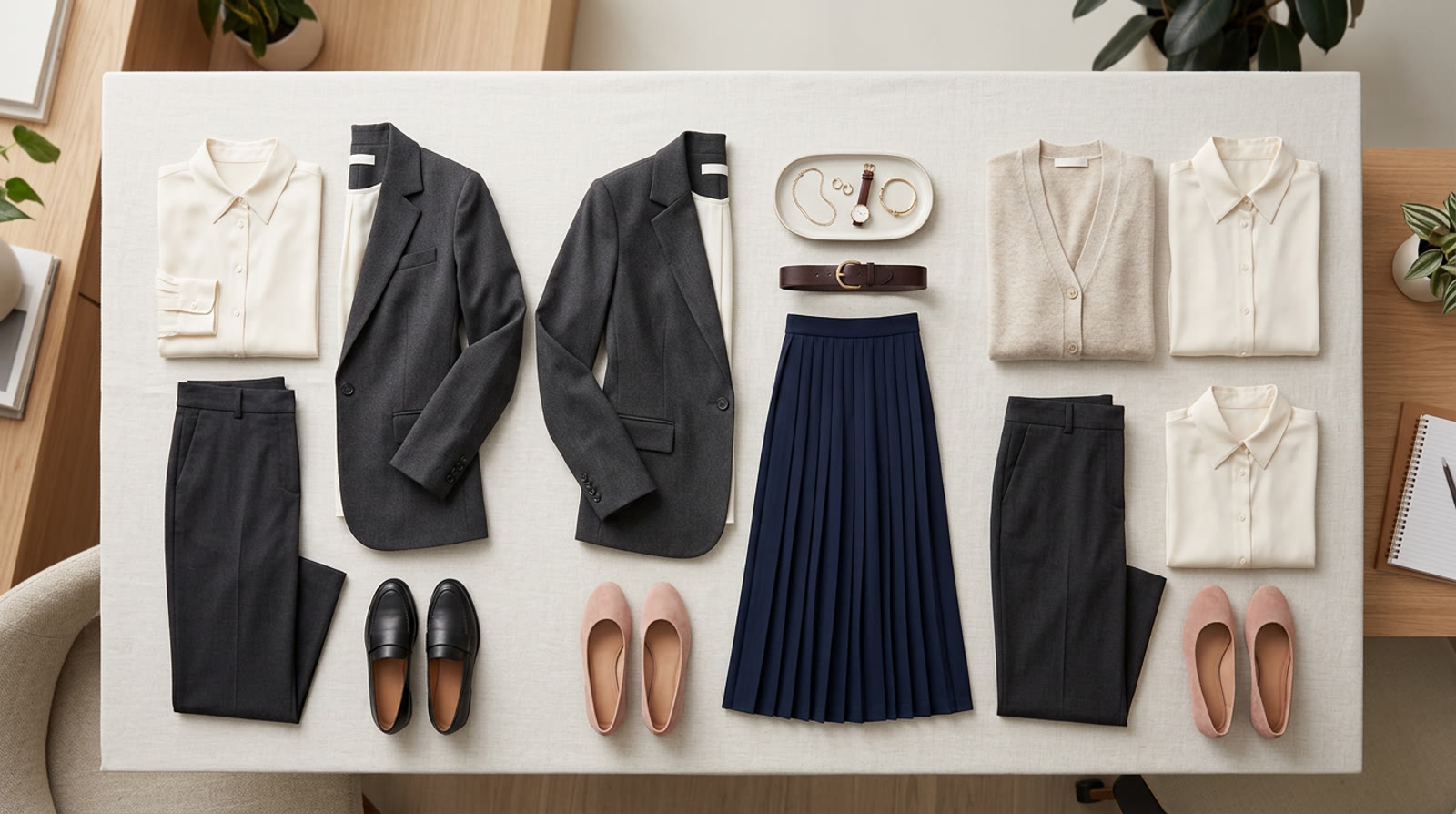
Work Outfit Formulas: Repeatable Office Looks for Busy Workdays
Work outfit formulas make weekday dressing faster because they give you repeatable combinations instead of starting over every morning. This page stays formula-first: it helps you build outfits that work for office, hybrid, business casual, smart casual, and polished everyday work settings.
If you need the broader wardrobe system behind the outfits, start with Work Capsule Wardrobe: A Practical System for Getting Dressed Faster. If the dress-code language is still fuzzy, Business Casual vs Smart Casual: What’s the Difference? will help you separate the two settings. If you want the general definition of the pattern itself, What Is an Outfit Formula? A Simple Definition and How It Works is the lighter bridge page.
The Work Formula Loop
A strong work outfit formula usually has five parts:
- Base — the piece closest to the body that anchors the outfit.
- Balance — the bottom or second piece that creates the overall shape.
- Polish — the layer, texture, or structure that makes the outfit feel finished.
- Finish — the shoe or accessory layer that keeps the look work-appropriate.
- Repeat — the small change that lets you reuse the same formula without looking identical.
That loop keeps the page focused on outfits, not wardrobe theory. If you want the closet logic that supports the formulas, Capsule Wardrobe Systems for Women Who Want Repeatable Outfits and Capsule Wardrobe Staples: The Pieces That Make the System Work are the next supporting pages.
What counts as a work outfit formula
A work outfit formula is a repeatable outfit equation you can reuse on real workdays.
The best formulas are simple enough to remember, but flexible enough to handle meetings, commute time, layering, temperature changes, and different levels of polish.
A formula should help you:
- get dressed faster on weekdays
- look intentional without reinventing your outfit every day
- adjust for office, hybrid, business casual, or smart casual settings
- stay comfortable through sitting, walking, and commuting
- repeat outfits in a way that still feels fresh
This is not a shopping list and it is not a generic inspiration gallery. It is a repeatable outfit system you can actually use.
8 repeatable work outfit formulas
These are examples, not rules. Use the structure, then substitute pieces that fit your office, your climate, and your comfort level.
1. Blouse + tailored trouser + blazer + loafer
A dependable formula for days when you want an easy polished baseline.
Quick substitutions:
- swap the blouse for a fine-knit top if you want less fuss
- swap the tailored trouser for a straight pant if you need a softer shape
- swap the blazer for a cardigan in a less formal office
- swap the loafer for a flat or low block heel if you want a lighter finish
Practical note: this formula works well for meetings, presentations, and days when you want the outfit to look composed without feeling overcomplicated.
2. Fine-knit top + straight pant + cardigan + clean flat
A softer formula for hybrid days or offices that lean polished but not rigid.
Quick substitutions:
- swap the fine-knit top for a shell if you want a cleaner neckline
- swap the straight pant for an ankle pant if the silhouette needs more lift
- swap the cardigan for a soft blazer when you need a sharper edge
- swap the flat for a loafer when you want more structure
Practical note: this is a good comfort-first formula when you need to move, sit, and commute without feeling dressed down.
3. Shell + midi skirt + structured layer + low heel
A balanced formula that gives polish without relying on trousers.
Quick substitutions:
- swap the shell for a blouse if the day is dressier
- swap the midi skirt for a straight pant if you need more movement
- swap the structured layer for a cardigan if the office runs warm
- swap the low heel for a flat if you are doing more walking
Practical note: use this when you want a little more visual polish for client-facing work, lunches, or meeting-heavy days.
4. Polished tee + ankle pant + soft blazer + comfortable shoe
A low-friction formula for everyday work settings that still need to look pulled together.
Quick substitutions:
- swap the polished tee for a knit top if you want more coverage
- swap the ankle pant for a straight-leg pant if the ankle cut feels too casual
- swap the soft blazer for a cardigan if you want less structure
- swap the comfortable shoe for a loafer when the outfit needs more polish
Practical note: this formula is especially useful when you want an outfit that can move from desk work to meetings without a full change.
5. Shirt dress + layer + supportive flat
A one-and-done formula for mornings when you want the outfit to do most of the work.
Quick substitutions:
- swap the shirt dress for a knit dress if you want more stretch
- swap the layer for a blazer if the day needs more structure
- swap the supportive flat for a low block heel if the dress code is slightly dressier
- add tights or a light base layer when the weather turns cool
Practical note: this is one of the easiest formulas for commute-heavy days because the shape stays simple and the silhouette still reads work-ready.
6. Fine-knit sweater + wide-leg trouser + loafer + simple accessory
A clean formula for polished everyday work when you want a modern shape.
Quick substitutions:
- swap the fine-knit sweater for a tucked blouse if you want more formality
- swap the wide-leg trouser for a straight pant if you want a narrower profile
- swap the loafer for a low heel if the day calls for more polish
- swap the simple accessory for a belt or scarf if the outfit needs a focal point
Practical note: this formula is useful when you want the outfit to feel current, comfortable, and office-appropriate without being fussy.
7. Button-up shirt + dark jean or polished trouser + blazer + clean shoe
A smart-casual formula for offices that allow a little more ease.
Quick substitutions:
- swap the button-up for a knit polo or structured knit top if you want less rigidity
- swap the dark jean for a polished trouser if your office is more formal
- swap the blazer for a cardigan if the setting is more relaxed
- swap the clean shoe between a loafer, flat, or minimal sneaker if your office allows it
Practical note: this formula works best when the fabrics stay neat and the rest of the outfit is clearly intentional.
8. Column dress + long layer + stable shoe
A streamlined formula that keeps the look polished with very few moving parts.
Quick substitutions:
- swap the column dress for a fitted knit dress if you want more ease
- swap the long layer for a shorter layer if the proportions need more shape
- swap the stable shoe for a flat or low heel depending on the day
- add a light scarf or belt if you want a small change without rebuilding the outfit
Practical note: this formula is especially helpful on days when you need speed, comfort, and a clean silhouette all at once.
How to make the formulas work in real life
Work formulas are only useful if they survive the day.
That means paying attention to:
- office comfort: waistbands, sleeves, and fits that still feel good after several hours
- layering: enough structure to look finished, but not so much that you overheat
- commute: shoes and hemlines that still work when you are walking, driving, or taking transit
- meetings: a quick way to make the outfit feel more polished when needed
- temperature changes: layers that can come off or go on without breaking the outfit
- shoes: support, walkability, and polish all matter at once
The easiest fix is usually not a new outfit. It is a smarter substitution inside the formula.
How to repeat work formulas without looking identical
The point is repetition with variation, not copy-paste dressing.
To keep the same formula from looking too obvious:
- change one piece, not the whole structure
- rotate the layer before you rebuild the outfit
- shift the shoe from flat to loafer, or loafer to low heel
- change the texture, not only the color
- use the same formula at different levels of polish
- keep the proportions similar even when the pieces change
That is also why this page stays formula-first instead of becoming a wardrobe-system page. If you need the closet logic, go back to Work Capsule Wardrobe: A Practical System for Getting Dressed Faster and build the wardrobe around the formulas that already fit your week.
Business casual vs smart casual: how to adapt the same formulas
The same formula can work in both settings if you adjust the level of polish.
Business casual
Business casual usually asks for more structure.
Use:
- more tailored pants or skirts
- blazers or more polished layers
- cleaner shoes with a more finished shape
- fewer casual textures and fewer obviously relaxed pieces
Smart casual
Smart casual gives you more room to soften the outfit.
Use:
- finer knits and softer layers
- relaxed but still neat pants
- simpler shoes that still look intentional
- slightly less structure, while keeping the outfit composed
If you want a deeper explanation of where the line sits, Business Casual vs Smart Casual: What’s the Difference? is the better comparison page. This page only shows how formulas change once you already know the dress-code level.
Bridge back to the work capsule wardrobe
If you need the closet structure behind these combinations, go back to Work Capsule Wardrobe: A Practical System for Getting Dressed Faster. That page explains the system; this page explains the repeatable outfit formulas that make the system usable.
Bridge to the comparison page
If the only thing you still need is clarity on dress code language, move next to Business Casual vs Smart Casual: What’s the Difference?. Use that page to decide the level of polish, then come back here and choose the formula that fits it.
FAQ
What is a work outfit formula?
It is a repeatable outfit pattern you can reuse on office or hybrid days without rebuilding the look from scratch.
How many formulas do I need?
Most readers only need a handful. The goal is enough variety to handle real workweeks, not a huge closet of different outfits.
How do I keep formulas from feeling boring?
Change one variable at a time: layer, texture, shoe, or accessory. Keep the structure, but vary the execution.
Can these formulas work for both business casual and smart casual?
Yes. The base formula can stay the same, but the fabrics, layers, and shoe choices should shift with the dress code.
Do work outfit formulas replace a capsule wardrobe?
No. The wardrobe supplies the pieces. The formulas help you use those pieces quickly and consistently.
What if my office dress code changes from day to day?
Build the formula around the most polished version you need, then soften it on casual days by changing the layer or shoe.
Conclusion
Work outfit formulas are useful because they reduce decisions without forcing you into a rigid uniform. Once you know the shape of the formula, you can repeat it, adjust it, and keep it aligned with your real work life. Next, choose 2–3 formulas that match your real workweek, make one of them your default busy-morning option, and only use Business Casual vs Smart Casual: What’s the Difference? if you still need clarity on the dress-code line.