
Business Casual vs Smart Casual: The 5 Decisions That Separate Them
Business casual and smart casual use many of the same clothes.
That is exactly why the difference gets confusing.
A blazer can belong to either dress code. So can trousers, loafers, a midi skirt, or a fine-knit sweater. The difference usually comes from how many relaxed signals appear in the same outfit and how much structure remains around them.
If I had to separate the two quickly, I would use five decisions: the bottom, the layer, the shoe, the fabric, and the setting.
The shortest answer
Business casual: dress for the office first, then remove some formality.
Smart casual: start with polished everyday clothes, then add enough structure to make them intentional.
That sounds similar, but the starting point matters.
A blouse, tailored trousers, and loafers naturally sits in business casual.
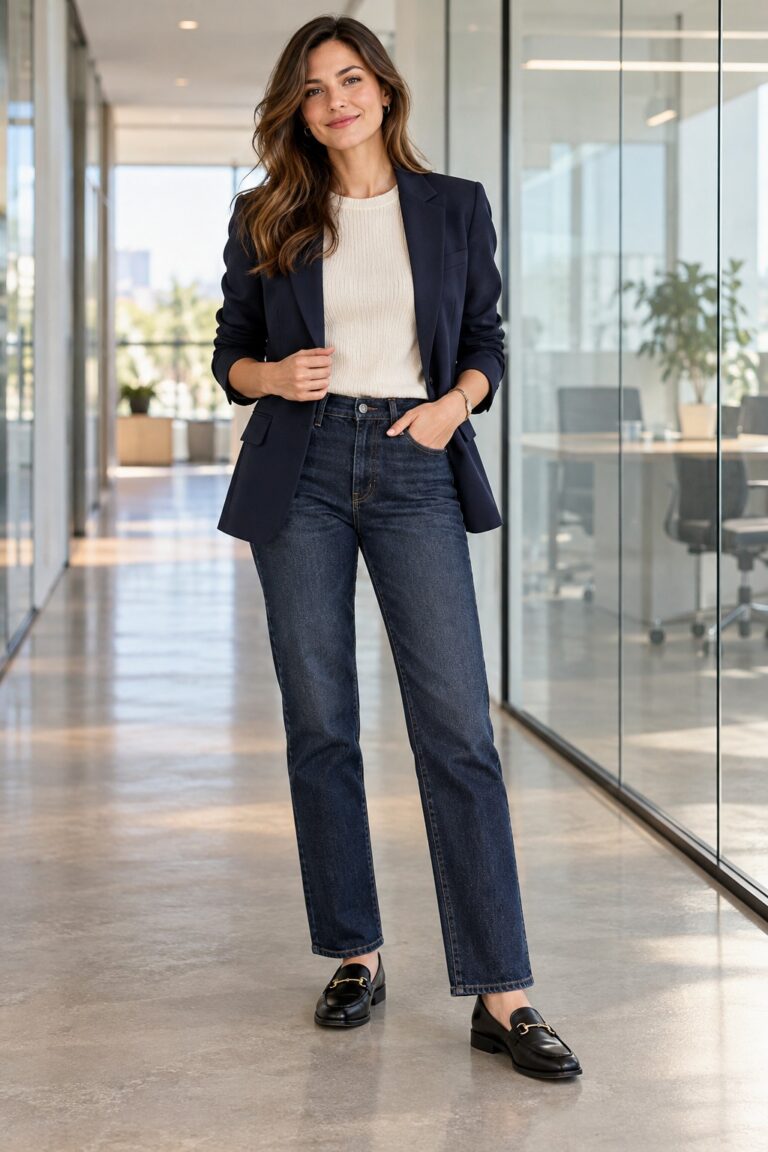
A fine knit, dark jeans, and loafers naturally sits in smart casual.
Add a blazer to either one and they become closer, but they do not automatically become identical.
1. The bottom usually tells you which direction the outfit is going
If I had to judge an outfit from one garment only, I would look at the bottom first.
| Bottom | My default judgment |
|---|---|
| Tailored trousers | Business casual |
| Straight ankle trousers | Business casual |
| Pencil or structured midi skirt | Business casual |
| Fluid wide-leg trousers | Either |
| Dark, clean denim | Smart casual unless the office clearly allows it |
| Chinos | Usually smart casual |
| Casual linen trousers | Smart casual |
| Distressed denim | Neither for most office settings |
This is not an absolute dress-code law.
It is a useful starting point.
Dark denim is the clearest example. Put it with a blazer, polished top, and loafers and it can work beautifully in a relaxed office. But the jeans are still doing the casual work.
That is why I would not call dark denim universally business casual.
2. A blazer does not automatically make something business casual
This is one of the most common shortcuts in online dress-code advice.
Adding a blazer helps, but it does not erase everything underneath it.
A blazer over tailored trousers and a blouse strengthens an already business-casual outfit.
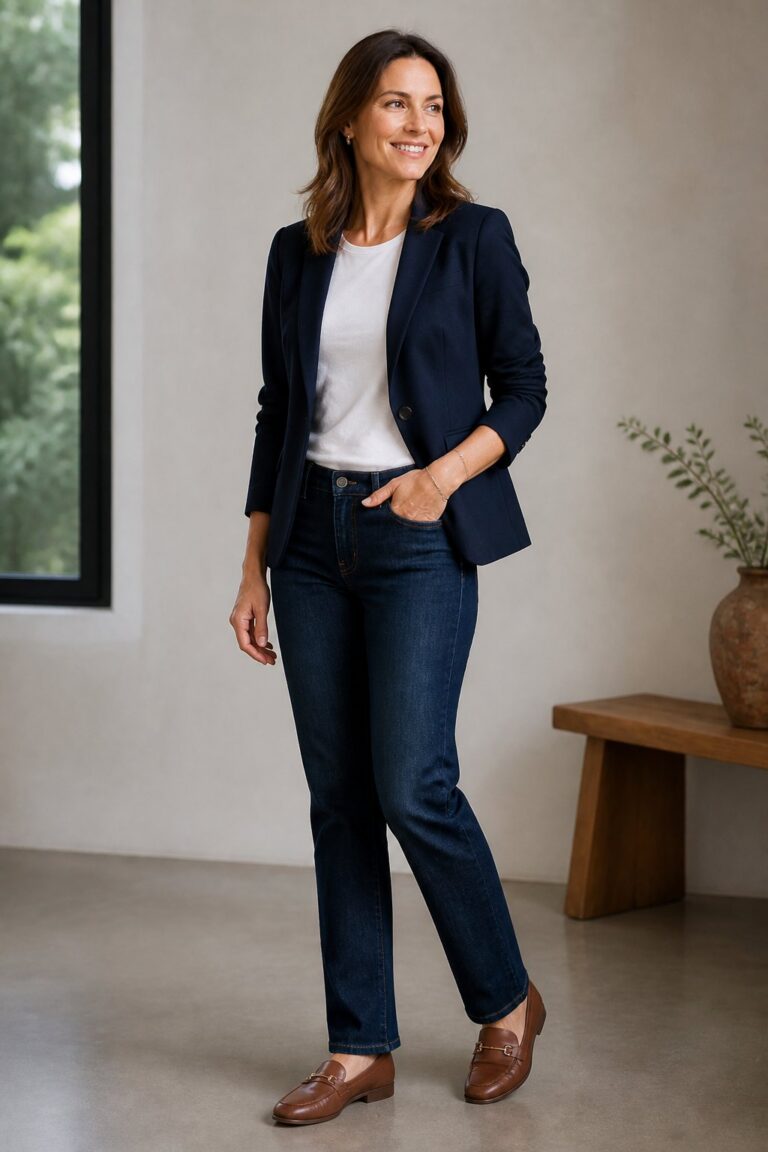
A blazer over dark jeans and a polished tee creates a strong smart-casual outfit.
A blazer over distressed jeans and sneakers does not magically turn the combination into office wear.
My rule is:
A structured layer can move an outfit roughly one step more formal. It cannot rescue several strongly casual elements at once.
That is more useful than treating “wear a blazer” as a universal solution.
3. Shoes can change the verdict without changing the clothes
Take the same blouse and trousers.
With loafers: clearly business casual.
With low block heels: slightly sharper business casual.
With sleek leather sneakers: closer to smart casual.
With high narrow pumps: moving toward corporate or formal business dressing.
The clothes have barely changed.
The message has.
This is why loafers are unusually useful in both wardrobes. They sit almost exactly between formal and relaxed.
If you are unsure whether an outfit is polished enough, upgrading the shoe is often more effective than replacing the entire outfit.
4. Fabric matters more than people think
Two garments can have the same name and belong to different dress codes.
A trouser in structured crepe reads differently from a soft drawstring trouser.
A fine merino sweater reads differently from a chunky weekend knit.
A crisp poplin shirt reads differently from an oversized washed-linen shirt.
So instead of asking only, “Are trousers business casual?” ask:
What does this particular pair of trousers communicate?
Look at:
- structure
- drape
- visible elastic
- wrinkles
- shine
- thickness
- tailoring details
- whether the fabric holds its shape
Business casual generally tolerates less visual softness.
Smart casual allows more.
5. The room matters more than the label
This is the most important rule.
A creative agency and a conservative financial office can both say “business casual” while expecting visibly different clothes.
That means internet definitions eventually stop helping.
When the dress code is unclear, I would judge the setting in this order:
- Client-facing or internal?
- Leadership-heavy or ordinary workday?
- Traditional industry or relaxed industry?
- Do people around you regularly wear denim or sneakers?
- Would you feel underdressed if an unexpected senior meeting appeared on your calendar?
If several answers point formal, lean business casual.
If the environment is visibly relaxed but still polished, smart casual is probably enough.
Five outfits, five verdicts
Blouse + tailored trousers + loafers
Verdict: Business casual
This is the safest baseline.
There are no strongly casual elements, but it is not formal enough to look like traditional corporate attire.
I would choose this when the workplace is unfamiliar.
Fine knit + wide-leg trousers + loafers
Verdict: Business casual, relaxed side
The trousers provide structure. The loafers keep the outfit grounded. The knit softens it.
This is what modern business casual often looks like when a blazer is unnecessary.
Blazer + dark jeans + polished top + loafers
Verdict: Smart casual first; business casual only where denim is accepted
This is where workplace context matters.
The blazer helps substantially, but denim remains the deciding element.
Midi skirt + knit top + flats
Verdict: Either
A structured skirt and fitted fine knit can read business casual.
A flowing skirt and softer knit can move toward smart casual.
This is a good example of why garment names alone are not enough.
Trousers + polished tee + clean sneakers
Verdict: Smart casual
The tailored trouser keeps it intentional, but the tee and sneaker combination pulls the outfit away from traditional business casual.
Replace either one with a blouse or loafer and the judgment becomes less clear.
The two-casual-signals rule
When I need a fast judgment, this is the rule I would use:
One casual element is usually manageable. Two may still work. Three usually moves the outfit out of business casual.
For example:
Tailored trousers + blouse + sneakers
One casual signal. Often workable.
Dark denim + blouse + loafers
One strong casual signal. Often workable in relaxed offices.
Dark denim + tee + sneakers
Three casual signals. Smart casual at best.
This rule is not official dress-code doctrine.
It is simply a practical way to judge the whole outfit instead of obsessing over whether one specific garment is “allowed.”
Where business casual becomes too formal
There is another boundary people overlook.
You can also overshoot business casual.
A structured blazer, pencil skirt, silk blouse, high pumps, and formal bag may all be perfectly appropriate, but together they can read closer to traditional corporate dressing.
Nothing is wrong with that.
It just means business casual has a formal edge as well as a casual one.
If everyone else is wearing soft knits, trousers, cardigans, and loafers, full tailoring may make you feel unnecessarily dressed up.
The goal is not maximum polish.
It is the right amount of polish for the room.
My decision table
| Situation | I would lean toward |
|---|---|
| First day in an unfamiliar office | Business casual |
| Client meeting | Business casual |
| Interview where dress code is unclear | Business casual |
| Internal hybrid-office day | Smart casual |
| Casual Friday with denim commonly worn | Smart casual |
| Creative workplace | Smart casual |
| Conservative professional office | Business casual |
| Dinner directly after work | Either, depending on workplace |
| Conference where you represent the company | Business casual |
| No clear information at all | Business casual |
When uncertain, slightly more polished is easier to adjust than obviously too casual.
You can remove a blazer.
It is harder to make distressed denim suddenly formal enough.
Business casual and smart casual should share most of a wardrobe
You should not need two separate closets.
A useful wardrobe can move between both dress codes by changing a few high-impact pieces:
Business casual version:
Blouse + trousers + blazer + loafers
Smart casual version:
Fine knit + same trousers + cardigan + same loafers
Or:
Business casual:
Button-up + ankle trousers + block heels
Smart casual:
Polished tee + same trousers + sleek sneakers
The underlying wardrobe stays similar.
The structure level changes.
That is why I would build the wardrobe around adaptable trousers, fine knits, blouses, one useful blazer, one softer layer, and shoes that can move between settings.
Plan the next step
If your workplace specifically calls itself business casual, use Business Casual Capsule Wardrobe: What Belongs, What Doesn’t, and Why to decide which pieces deserve a place.
If you need a broader work system, use Office Capsule Wardrobe: 15 Pieces I’d Choose for a Real Workweek.
Then put the actual week into the Weekly Outfit Planner. Dress-code advice becomes much easier when you are solving Monday's real meeting instead of trying to define your entire wardrobe at once.
Keep these outfit ideas handy.
Save this guide on Pinterest (opens in a new tab)More ideas for your wardrobe
 Work Outfit IdeasBusiness Casual Capsule Wardrobe: What Belongs, What Doesn’t, and Why
 Work Outfit Ideas8 Business Casual Outfits with Jeans for Different Office Dress Codes
 Work Outfit IdeasBusiness Casual Travel Outfits for Women Who Need Plane-to-Meeting Polish
 Work Outfit IdeasSmart Casual Capsule Wardrobe Ideas for Work and Weekend