
Capsule Wardrobe Checklist: Find What’s Actually Missing
A capsule wardrobe checklist should help you decide what needs fixing before you buy more clothes. A full closet can be difficult for several different reasons: the pieces do not combine well, the outfits take too much thought, or the right clothes are never ready when you need them.
Those problems need different solutions. The Outfit Method uses Pieces → Formulas → Planning to find the source of the friction. Start with the audit below, then use the interpretation that matches your result.
Interactive wardrobe diagnostic
Which part of your capsule wardrobe is actually failing?
Rate 15 statements across the three layers of The Outfit Method: Pieces → Formulas → Planning. The goal is not a perfect score. It is to find the layer creating the most friction.
Your diagnosis
Start with the weakest layer
Answer the statements above to build your diagnosis.
Not scored yet
Not scored yet
Not scored yet
Complete at least one full layer to generate a diagnosis.
This is a practical planning aid, not a scientific assessment. A lower score simply identifies where your wardrobe currently creates the most friction.
Private by default. Your answers and notes are stored only in this browser. This tool itself does not send your wardrobe answers to the server.
Read the scores before writing a shopping list
Each layer has five statements. Yes scores 2, Sometimes scores 1, and No scores 0. A completed layer scores out of 10: 8–10 is Strong; 5–7 is Workable, but inconsistent; 0–4 is Needs attention.
Complete all 15 statements for a comparison across the whole system. With a partial audit, the tool can only compare completed layers; an unanswered layer is not a zero. The numbers are a practical way to organize your decisions, not a scientific measurement of style, confidence, or wardrobe quality.
| Layer | What to check | Useful first step |
|---|---|---|
| Pieces | Compatibility, roles, layers, and usable footwear | Try combinations with clothes you already own |
| Formulas | Repeatable structures that survive substitutions | Build three flexible outfit formulas |
| Planning | Readiness for your schedule, weather, and laundry | Plan one real week with backup options |
Your answers and optional notes save in the browser you are using. They are not automatically available on another device, and clearing that browser’s stored site data can remove them. Use the Copy results or Print results controls if you want to keep a separate summary.
If Pieces is weakest, test connections rather than quantities
Imagine two wardrobes with four tops, three bottoms, two layers, and two pairs of shoes. In the first, several tops work with each bottom. In the second, each top needs one particular bottom and only one shoe suits the finished outfits. The item count is the same; their usefulness is different.
Choose three pieces you often wear. For each, try to make two or three realistic outfits using clothes already in the closet. Include the shoes and layer you would actually need. A combination that depends on future purchases is a possibility, rather than an outfit available today.
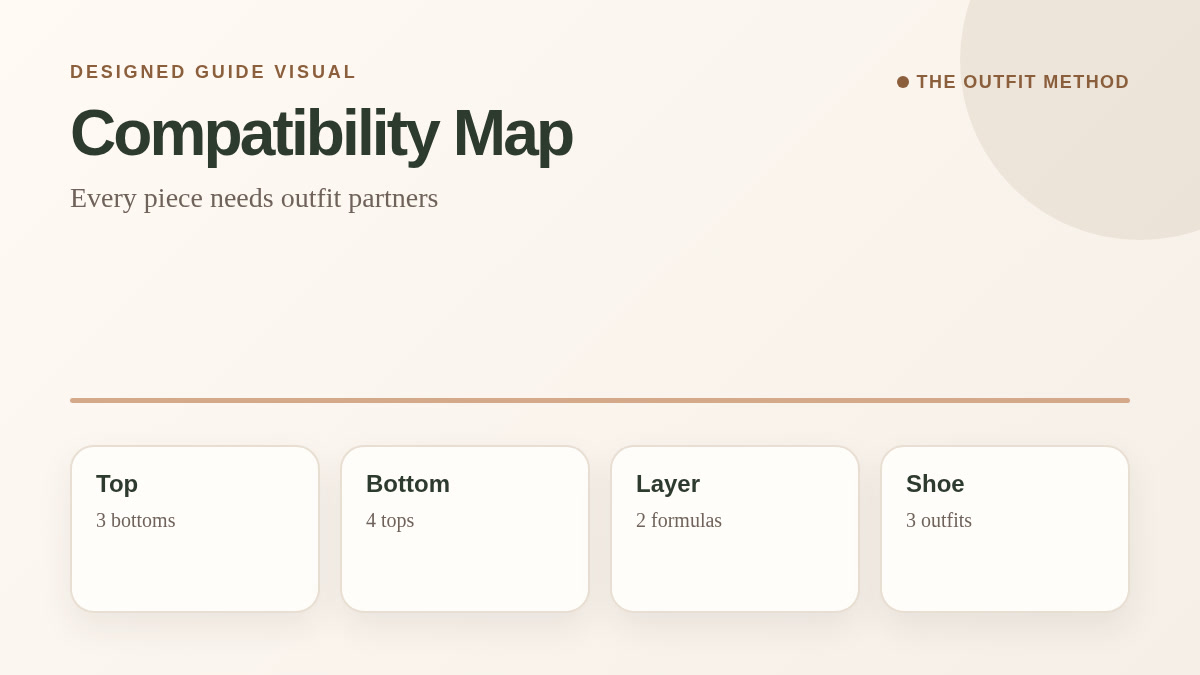
The diagram is a prompt to look for outfit partners, not a mandatory target for every garment. A specialist uniform, sentimental piece, or occasion outfit can have a narrower job. The question is whether you understand that job before buying more pieces around it.
Find the bottleneck that stops finished outfits
Suppose five tops and three trousers combine well, but only one pair of shoes is comfortable enough for the commute. Another blouse adds variety without solving the repeated problem. A suitable shoe may make more existing combinations usable.
That does not mean shoes should always come first. Your bottleneck might be a layer that fits over your actual tops, a bottom that works with several blouses, or an item that is repeatedly unavailable because of its care requirements. Identify the constraint before choosing the purchase.
For help judging the role of a piece, use Capsule Wardrobe Staples. Try substitutions before deciding that anything is missing.
If Formulas is weakest, build outfits that survive a swap
A good Pieces score with a weak Formulas score suggests that you may have useful clothes without reliable combinations. Start with three structures: blouse + trousers + loafers; knit + skirt + boots; or dress + cardigan + flats. Adapt the structures to the settings you actually dress for.
Now change one garment at a time. Can another blouse take the same role? Can the cardigan replace the jacket? Does the shoe still work with the new hem length? A structure that allows several sensible substitutions gives you a shortcut. One precise combination that collapses when a garment is in the wash is a complete outfit, but not yet a flexible formula.
Do not assume that every substitution should work. A bulky sleeve may need a different layer; a longer skirt may need a different shoe. Noticing the exception makes the formula more useful. Read What Is an Outfit Formula? for the underlying approach.
If Planning is weakest, connect the closet to next week
Strong pieces and formulas cannot solve a week you have not considered. Check the actual occasions, formality, forecast, walking or standing, laundry timing, and days that could change unexpectedly. Then assign outfits you can realistically have ready.
The Weekly Outfit Planner lets you map seven days and notice repeated pieces. Use it for a complete week before judging the result. One difficult morning is weak evidence of a missing garment; the same obstacle appearing repeatedly deserves a closer look.
When a formula relies on one frequently washed top, try a substitute or change the laundry plan before shopping. When an uncertain day has no backup, prepare an alternative that fits the likely change in weather or dress code.
What to do when two layers tie
A tie means there is more than one plausible starting point. If Pieces and Planning are both low, ask what fails first. If you cannot assemble usable combinations, start with compatibility. If the combinations already work but are not ready when needed, start with planning.
You do not need to fix everything at once. Choose the problem that recurs most often and make one change you can test. Repeat the audit after that change has had a chance to affect your routine.
Sort by usefulness without rushing to discard
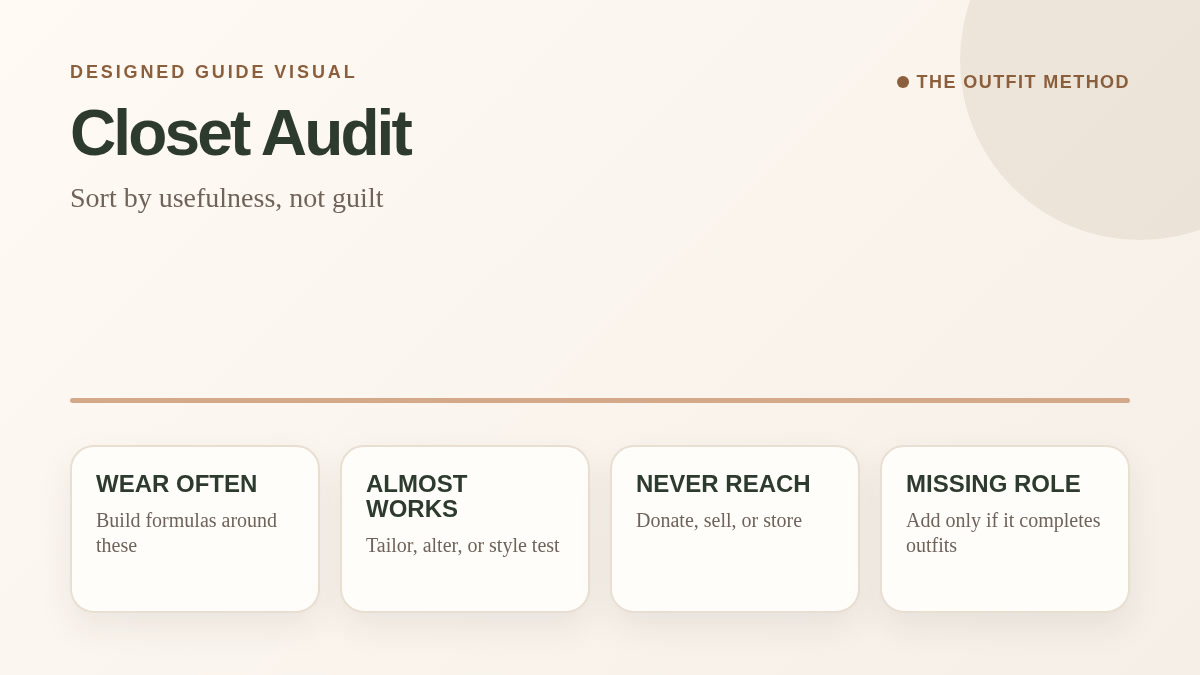
Use temporary groups if sorting helps: wear often, almost works, rarely reached for, and a possible missing role. “Almost works” deserves a fit or styling test before you make a decision. “Rarely reached for” may include sentimental, specialist, seasonal, or occasional clothing worth keeping. It is not an automatic instruction to donate or buy a replacement.
Before buying, ask whether the problem repeats, whether something you already own can solve it, and whether the proposed piece improves several realistic outfits. A single-purpose purchase can still be sensible for a specific job; just be clear about that job.
Plan the next step
Choose one action from your weakest layer. Test existing combinations for Pieces, write three repeatable structures for Formulas, or prepare seven real days for Planning. At the end of the week, ask whether that change made getting dressed easier.
Use Capsule Wardrobe Systems for the full framework, Capsule Wardrobe Staples for garment roles, and the Weekly Outfit Planner for the coming week. Progress means a more usable wardrobe, not three perfect scores.