
9 Elementary Teacher Outfits for Floor Time and Hallway Duty
An elementary school outfit has to do more than look ready for the classroom. In one morning, a teacher may sit on the floor beside a student, reach for a shelf, walk a hallway, stand through a lesson, and head into a meeting without a chance to change. The most useful teacher outfits begin with movement and the school’s actual dress code, then add polish in ways that do not make the day harder.
These nine formulas focus on classroom movement, hallway duty, and the transitions between them. They are not universal uniforms: schools differ on denim, footwear, coverage, and spirit-day rules, and each person has different comfort needs. Treat the outfit as a starting point, then use the movement checks under each look to decide whether a similar combination will work for your own day.
Before planning a week, check the tasks that repeat most often. Do you kneel, sit cross-legged, use stairs, supervise outdoors, or carry supplies? Does your classroom run warm or cold? Does your school allow jeans every day, only on certain days, or not at all? Those answers matter more than a generic label such as “teacher casual.” A practical outfit is one that lets you do the work without constant tugging, adjusting, or protecting a delicate piece.
What makes an elementary teacher outfit classroom-ready?
Start with the movements you expect, not a picture of an idealized classroom. Try a gentle bend, reach, squat, and seated position in each outfit before wearing it for a long day. Notice whether the waistband shifts, a neckline moves, a hem catches, or a shoe slips. The goal is not to pass a rigid test or to hide your body. It is to spot preventable discomfort before you are carrying books through a busy hallway.
Next, consider what can be washed or protected easily. Art supplies, playground dust, snack spills, and ordinary classroom wear can be hard on delicate fabrics. A washable base with a removable layer gives you options: keep the polished layer on for a meeting, take it off for a messy activity, or wear it open when the room warms. Pockets help only when they sit securely and do not make the garment sag; a small crossbody bag or lanyard may be better for items you need all day.
Footwear should match the surfaces and distance you cover. A shoe that feels fine for a short commute may not work for several hours of standing, stairs, and playground duty. There is no one correct shoe for every foot or school; look for a secure fit and enough support for your own needs. If your school has specific footwear rules, follow those first.
9 elementary teacher outfits for floor time and hallway duty
1. Ponte pull-on trousers, a smooth tee, a long cardigan, and supportive sneakers
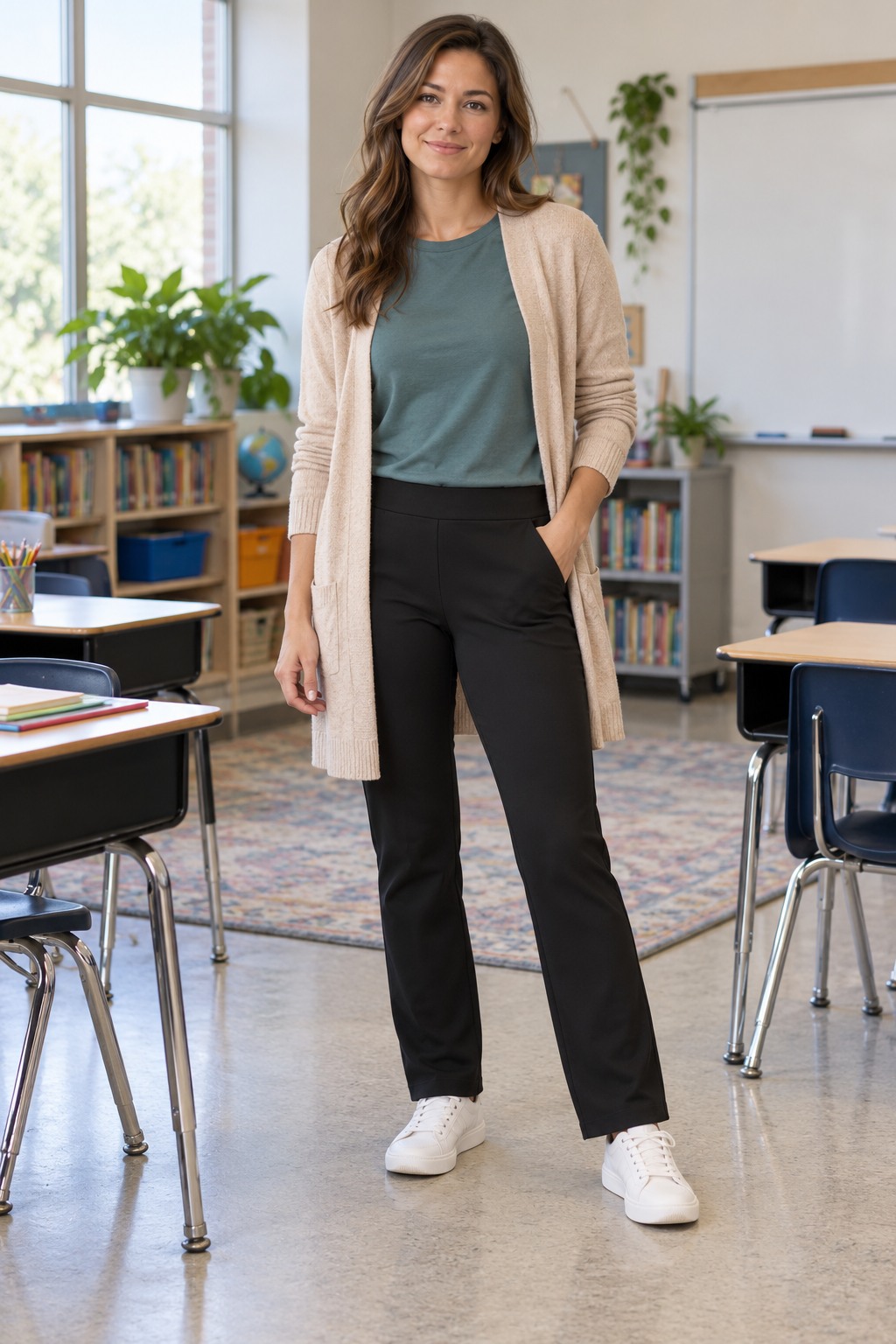
Ponte or another comfortable stretch trouser can look more polished than a jogger while still allowing you to bend and sit. Pair it with a smooth tee that stays put when you reach, then add a long cardigan for a cooler classroom or a parent conversation. Supportive sneakers make sense if the day includes hallway duty, stairs, or outdoor transitions. Keep the palette simple and let one color in the cardigan or shoe add personality.
Before you commit, sit on a low chair or crouch as you might beside a student. The waistband should stay comfortable, and the cardigan should not drag on the floor or fall forward into your workspace. If the room is warm, remove the cardigan and still have a complete outfit underneath. If your role requires frequent kneeling, choose trousers that do not become sheer or tight across the knee when bent, and check the fabric label for care needs.
This formula is adaptable rather than tied to one body shape. A shorter cardigan, tunic-length top, or different rise may feel better depending on your proportions and school tasks. If sneakers do not work for your feet or dress code, swap in a stable flat or another secure shoe you already know is comfortable.
2. Ankle trousers, a washable button-front shirt, a knit blazer, and closed flats
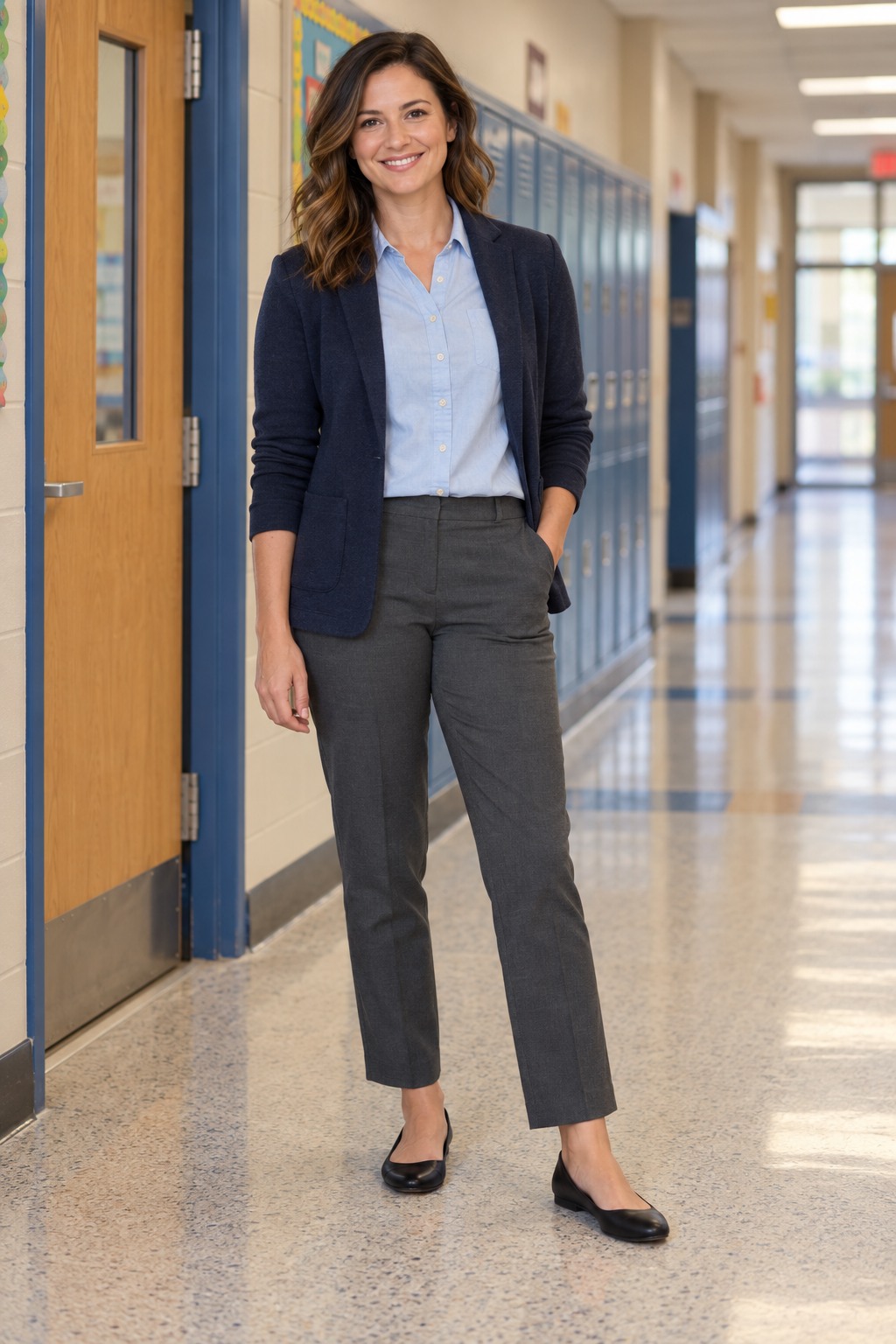
For a day that includes teaching, hallway coverage, and a meeting, choose ankle trousers with a washable button-front shirt and a soft knit blazer. The shirt creates a clean base, while the knit jacket adds structure without feeling as restrictive as a stiff tailored layer. Closed flats can keep the look polished while staying practical for indoor movement, provided they fit securely and suit your walking needs.
Check the shirt while reaching overhead and leaning toward a desk. If it pulls at the buttons or opens more than you like, try a different fit, a camisole layer if comfortable, or a knit top with a similar collar. The blazer should let you lift your arms without tugging at the shoulders. An ankle hem can reduce fabric catching near the floor, but the best length depends on your height, shoe, and preference.
To make the outfit more classroom-friendly, choose a color and fabric that will not show every small mark, and keep accessories low-profile if you move among desks. At the end of the day, you can remove the blazer for an activity that may involve paint or glue. If your school culture is more casual, replace it with a washable cardigan while keeping the same trousers and shirt.
3. A washable midi dress, a light overshirt, and secure low-profile shoes
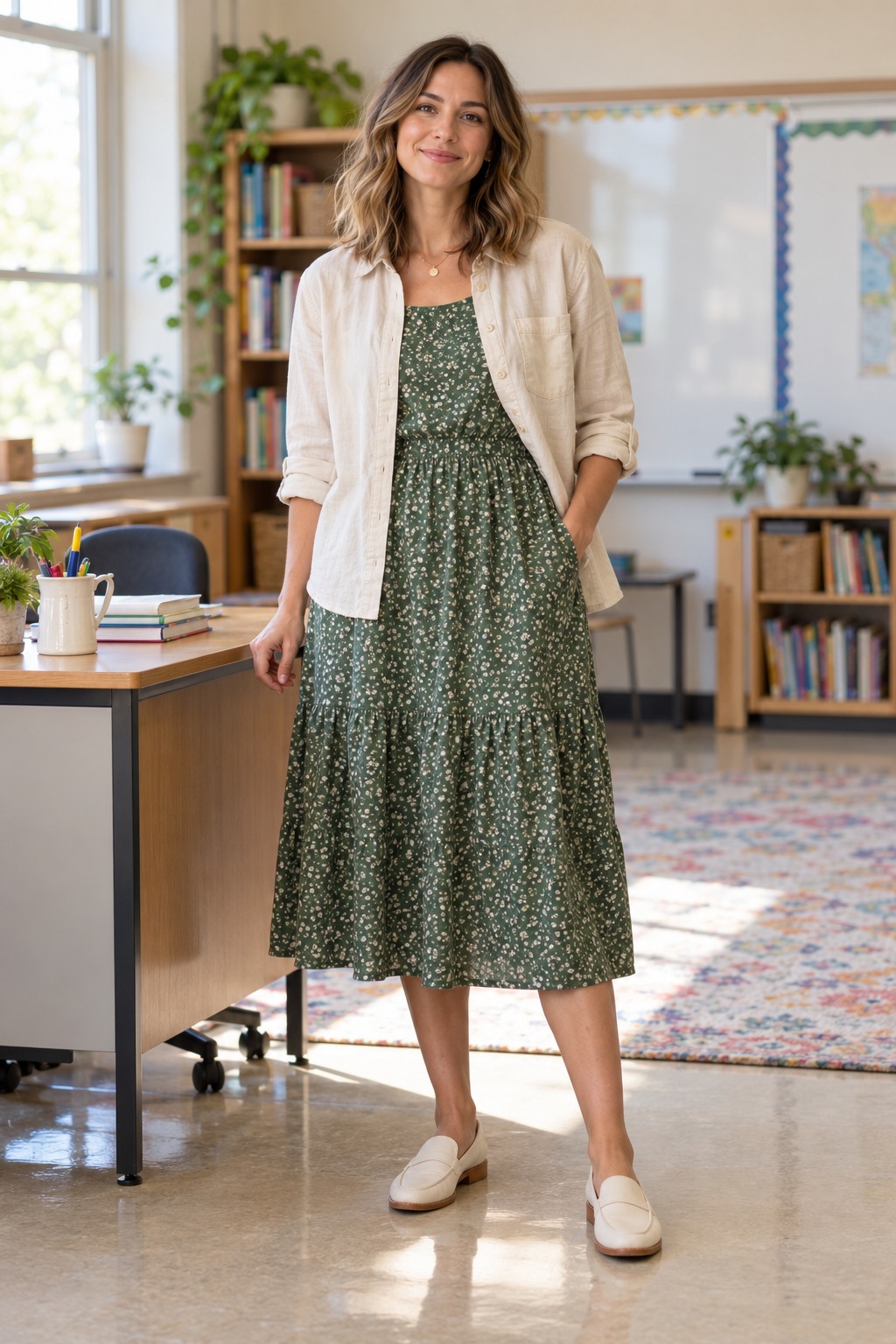
A one-piece dress can simplify a busy morning, but classroom movement should guide the cut. Choose a washable midi dress that allows a full stride, then add a light overshirt or cardigan that can be removed indoors. A simple solid or small print makes it easy to add a colorful lanyard or school accessory without turning the outfit into a costume. Low-profile shoes with a secure fit support a day spent moving between desks and doorways.
Test the dress by sitting on the floor, reaching up, and taking a long step. Check that the hem does not ride too high, catch under a knee, or brush the floor. If you prefer additional coverage for bending, shorts or leggings may be a comfortable personal choice, but they are not a requirement for everyone. A slip, lining, or different fabric weight can also change how a dress behaves; inspect the garment in natural light and while moving.
For cooler mornings, use the overshirt as the removable layer rather than adding several pieces that bunch at the waist. If you have an active outdoor duty, consider whether the dress fabric and shoe choice work for the surface and weather. A skirt or dress is only practical when it suits the actual job and the wearer’s comfort, so choose another formula freely if this one gets in the way.
4. Dark jeans, a washable tee, a chore jacket with pockets, and sturdy sneakers
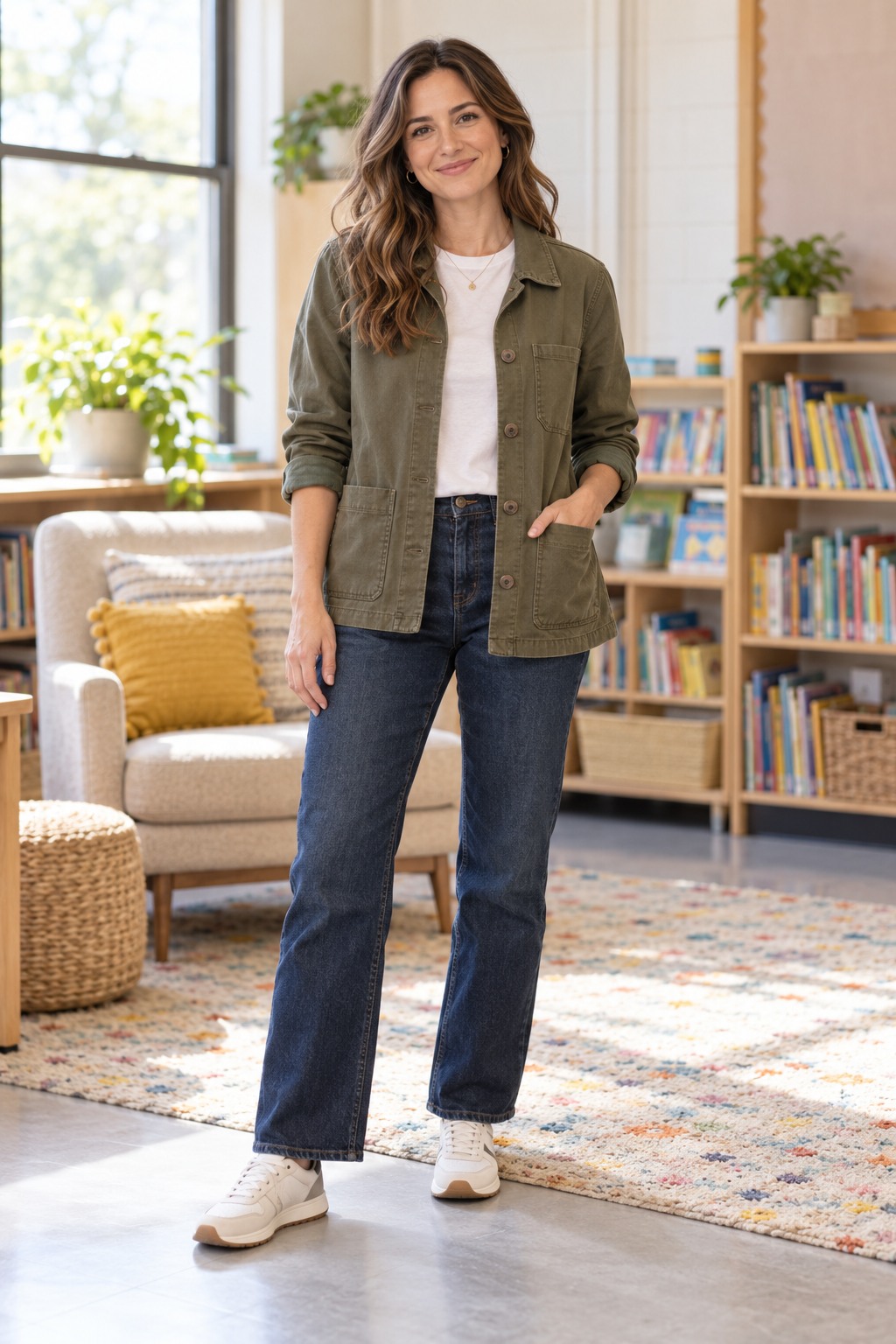
When jeans are allowed, dark straight-leg denim can form a durable base for a day with movement and supplies. Add a washable tee and a chore jacket with useful pockets, then finish with sturdy sneakers. The jacket gives the outfit structure and a place for small essentials, but keep pockets light so the fabric does not pull. This is a practical casual-Friday option or an everyday formula in schools with a relaxed dress code.
Dress codes vary widely, so check local guidance rather than assuming dark denim is always acceptable. If jeans are not allowed, use a dark ponte trouser or cotton twill pant in the same silhouette and keep the jacket and shoes. If you do wear denim, check the seat and knees in a squat, and choose a stretch level that lets you move without losing shape. A clean, undistressed finish usually reads more polished than heavily faded or ripped denim.
For a meeting after class, leave the jacket open over the tee, add a simple belt if comfortable, or switch to loafers if the route and your feet allow. You do not need a second outfit to look prepared. The useful idea is the adaptable layer, not the assumption that every classroom requires the same level of formality.
5. A stretch midi skirt, fine knit, cropped cardigan, and stable ankle boots
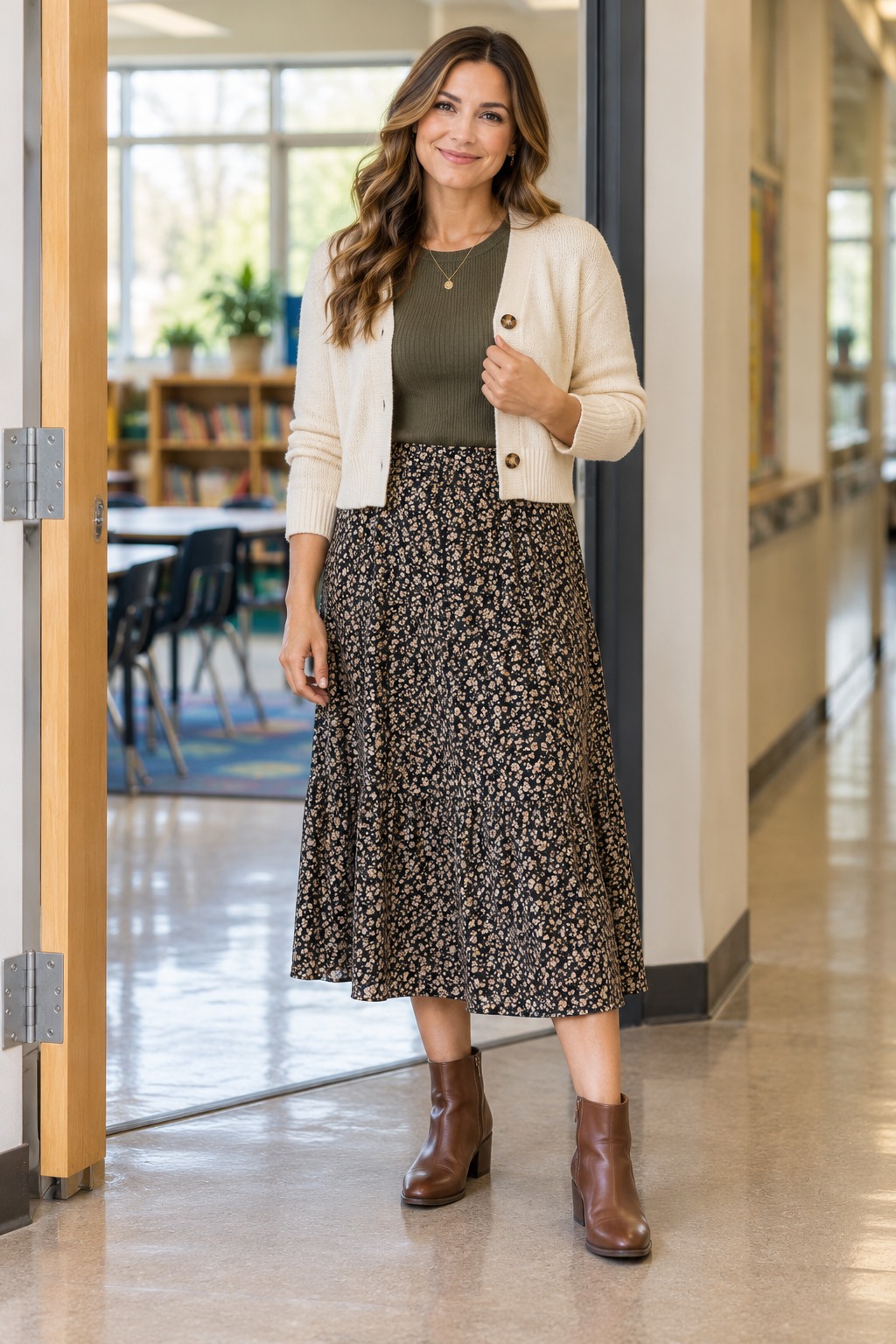
If skirts are part of your wardrobe, a stretch midi skirt can offer a different option from trousers. Pair it with a fine knit and a cropped cardigan that will not fall into a desk or brush the floor. Stable ankle boots can add coverage on a cool day, while a low flat or sneaker may be more comfortable for extended walking. Keep the skirt’s waistband and fabric easy to move in rather than relying on the outfit to look a particular way.
Try a full stride, a step onto a low platform, and a seated position. A narrow skirt may restrict movement even when it looks fine standing still; a small slit or a fuller cut can help, depending on what feels comfortable. Check the hem in stairs and on a chair. If you supervise outdoors, think about weather and the surface underfoot. A skirt does not need to be avoided, but it should let you do your job without guarding every movement.
For a cooler room, add a thin base layer under the knit or choose a warmer cardigan. At a warmer school, keep the top lightweight and use the cardigan only when needed. If your personal preference is trousers, use the same color balance and layer idea with a stretch trouser; the useful principle is comfort plus adjustability, not the skirt itself.
6. A skort or pull-on trouser, a breathable polo, and a light overshirt
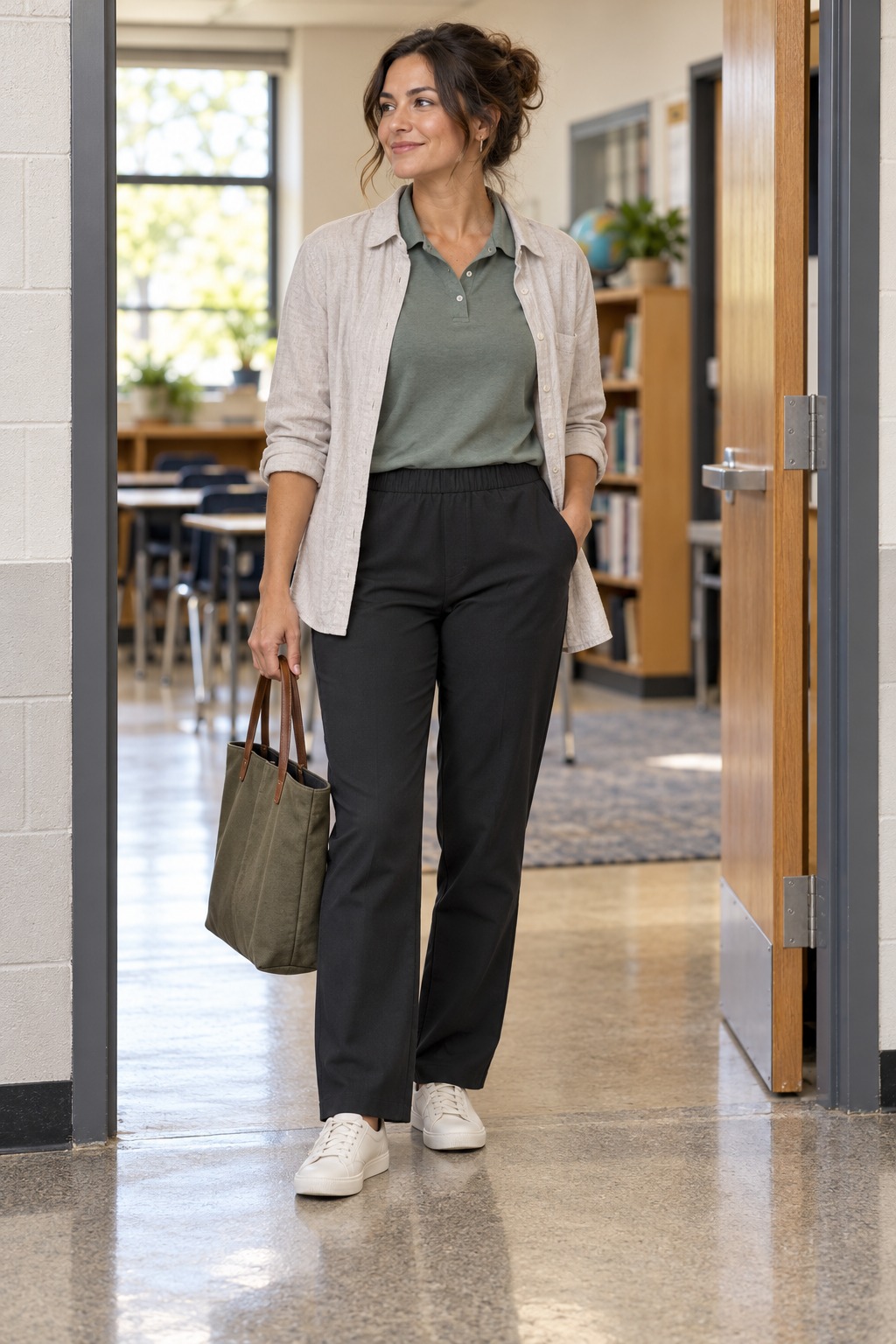
For a day that moves between classroom instruction and outdoor duty, choose a breathable top with a lightweight layer that can be removed quickly. Pull-on trousers or a suitable skort give you room to move, while an overshirt can add coverage without the stiffness of a structured jacket. Check the school’s expectations for shorts and skirt lengths before using a skort, and choose fabric that stays comfortable in warm weather.
Keep pockets practical and test the outfit with the shoes you will wear. If you carry keys, cards, or a whistle, a secure pocket or small crossbody may be more useful than a decorative layer. The formula should allow you to walk briskly, bend, and reach without adjusting a hem or neckline throughout the day.
7. Straight-leg chinos, a soft sweatshirt, and a collared layer
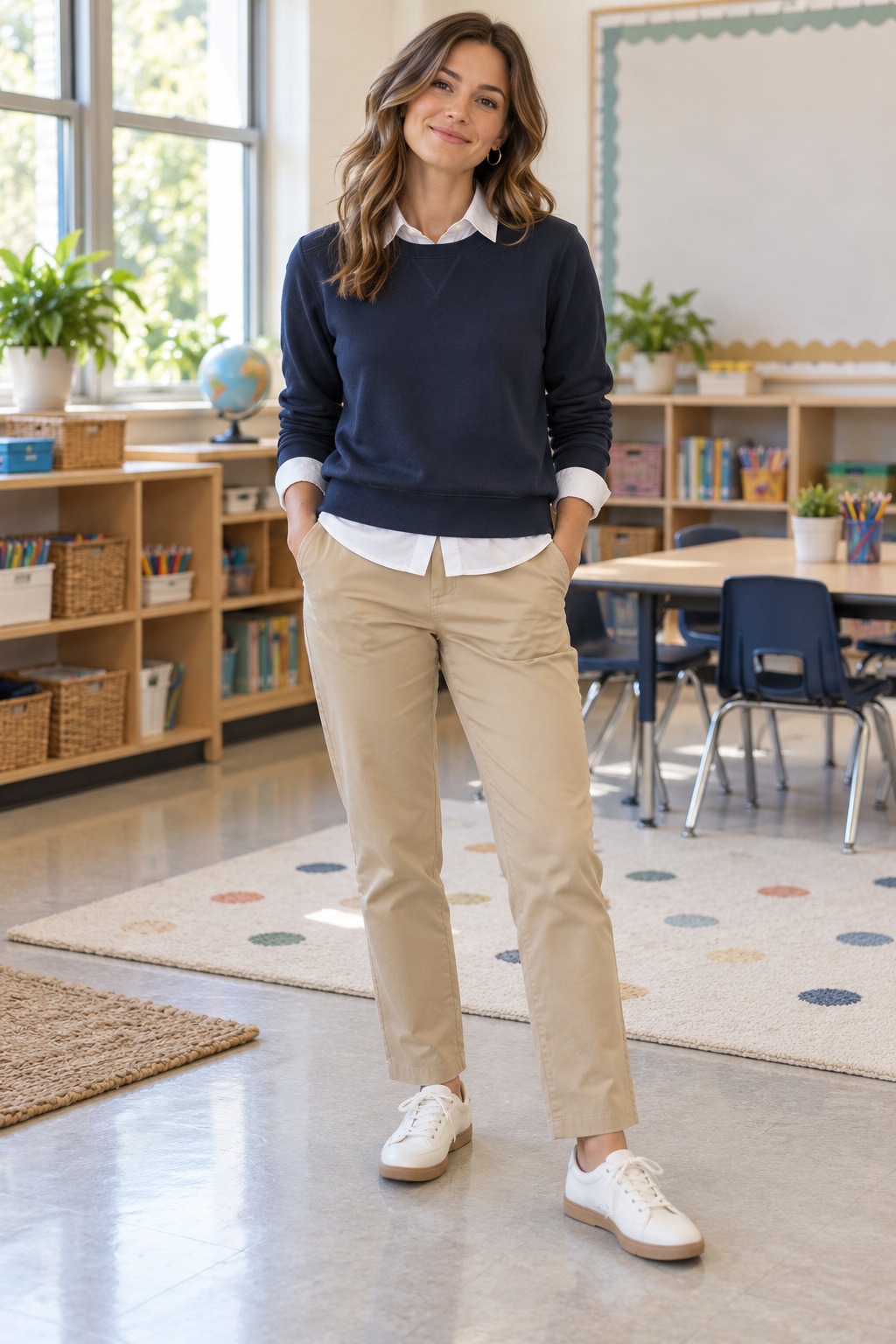
On a casual classroom day, straight-leg chinos and a soft sweatshirt can offer comfort without feeling like sleepwear. A collared shirt beneath the sweatshirt or an open shirt-jacket creates a more finished neckline. Keep graphics minimal if you want the look to work for meetings as well as class, and check that the sleeves stay out of the way during hands-on activities.
Choose a sweatshirt with enough ease to reach and write on the board without pulling across the shoulders. The layer beneath can be removed if the room warms up. A clean sneaker, loafer, or supportive flat completes the outfit according to your school’s dress expectations and how much standing the day involves.
8. A wrap-style knit dress, opaque tights, and a washable cardigan
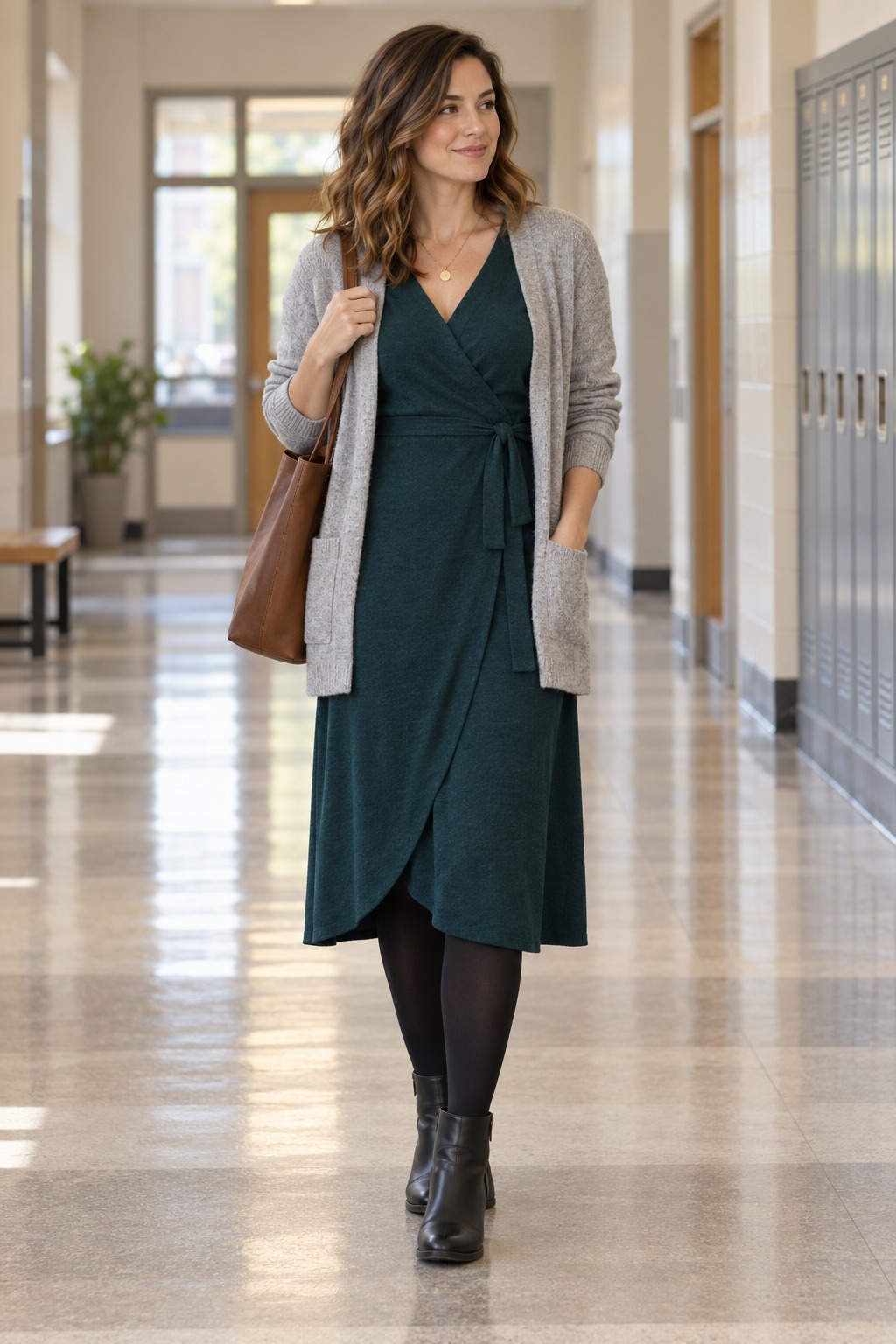
A wrap-style knit dress can make a one-piece base for a day with assemblies, conferences, or classroom teaching. Select a neckline and length that remain secure when you lean or sit on the floor, and pair the dress with opaque tights when the weather or school setting calls for more coverage. A washable cardigan adds warmth and can be removed during active parts of the day.
Before wearing a wrap design to work, test it through ordinary classroom movements. If the neckline shifts, use a discreet fastening or choose a faux-wrap style. Soft flats or stable boots can support a long day on your feet. The most useful version is the one that feels secure without frequent adjustment.
9. Stretch chinos, a longline vest, and a smooth long-sleeve top
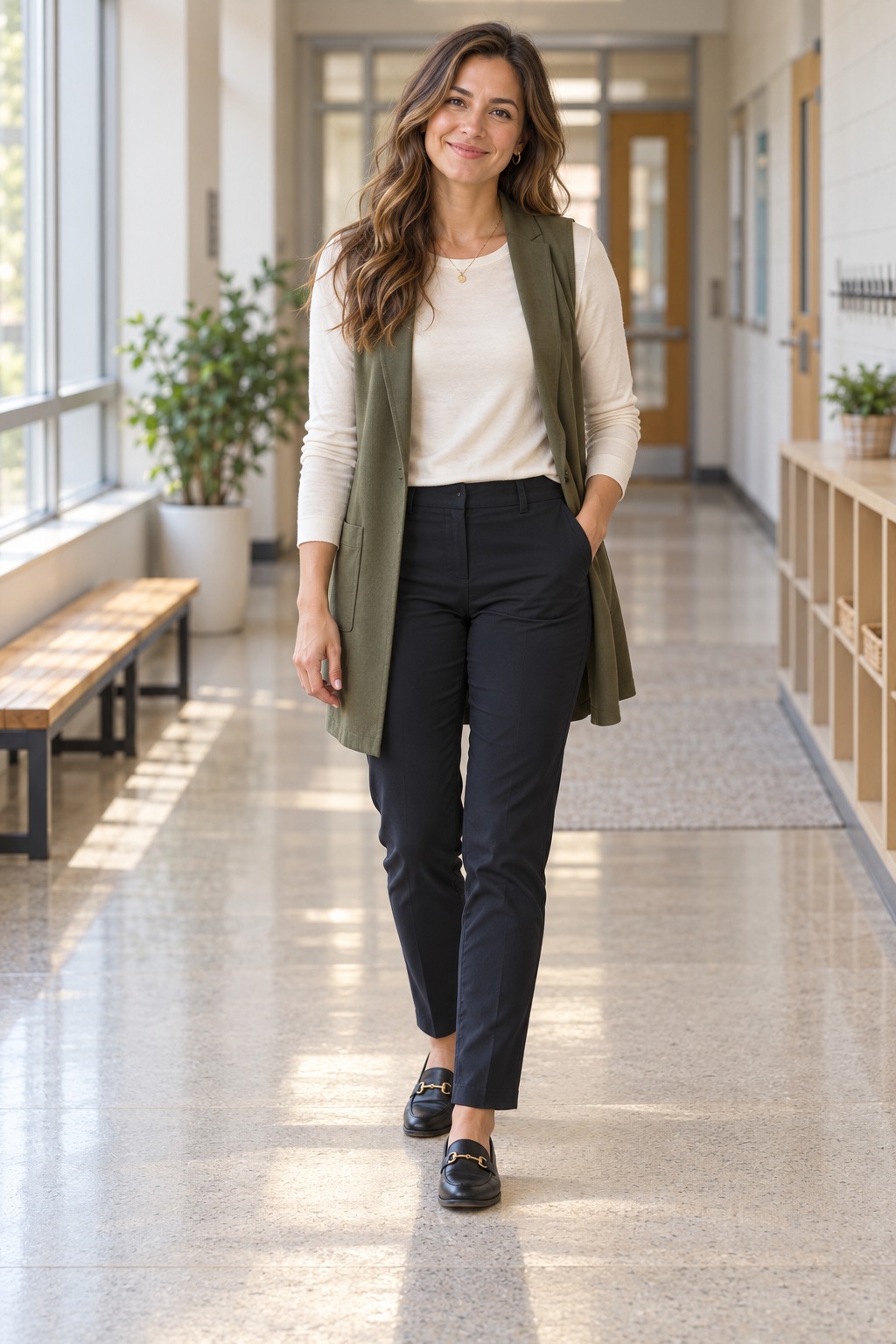
For a day when you want a little more polish without a heavy jacket, pair stretch chinos with a smooth long-sleeve top and a longline vest. The vest creates a clean vertical line and leaves the arms free for writing, lifting books, or helping students. Choose a vest that stays open comfortably and does not swing into work surfaces when you bend over a desk.
This formula can transition from teaching to a staff meeting with a shoe change or a simple accessory, but it still needs to suit the school’s dress code. If the room is warm, a sleeveless vest can be easier than a blazer. If you prefer more coverage, use a knit vest or open cardigan with a similar length and shape.
A quick movement-and-comfort check before the school week
Set aside a few minutes to try each planned outfit as a complete set, including the shoes and any layer you expect to carry. Practice the movements your actual role involves: bending to a low shelf, kneeling, sitting beside a student, walking a hallway, and reaching overhead. Pay attention to whether you have to keep adjusting a hem, neckline, waistband, or shoe. If a piece needs constant attention, change the fit or substitute a more practical option before wearing it for a full day.
- Movement: Can you bend, reach, sit, and take a full step without restriction?
- Coverage: Does the outfit stay in place in the positions you use at work?
- Comfort: Are the layers and shoes suitable for your classroom temperature and walking needs?
- Care: Can you wash or protect the fabrics in a way that fits your routine?
- Dress code: Does the outfit meet the actual guidance at your school?
Common questions about elementary teacher outfits
Are jeans appropriate for elementary teachers?
That depends on the school or district. Some allow jeans daily, some limit them to designated days, and others do not include them in the dress code. Check the policy or ask a supervisor if you are unsure. When denim is not appropriate, dark stretch trousers or cotton twill pants can fill a similar role in a casual outfit.
What shoes are practical for a teacher who stands all day?
Choose a secure shoe that suits your feet, school surfaces, weather, and expected walking. Support needs vary, so there is no universal shoe recommendation. Test a new pair on a shorter day before relying on it for a long shift, and follow any school-specific footwear rules.
How can I make an outfit work for both classroom and hallway duty?
Start with a base that feels complete on its own, add one removable layer, and choose shoes that work for the longest or most active part of your day. Keep hems clear of the floor and make sure layers stay in place when you reach or bend. If your schedule includes outdoor duty, plan for the weather as well as the classroom temperature.
How many teacher outfits do I need for a workweek?
There is no required number. A small rotation can work if the pieces are comfortable, clean, and appropriate for your school. Repeating trousers with different tops or changing one outer layer can create variety without buying a new outfit for every day. Laundry routines, climate, and personal preferences will affect what is practical for you.
Build a repeatable teacher wardrobe around your real day
The best classroom outfit is not the most elaborate one; it is the one that lets you teach, move, and respond without thinking about your clothes all day. Start with the movement check, keep the school’s dress code in view, and choose layers that can adapt when the classroom or schedule changes. Use the nine formulas as flexible templates, repeat the pieces that already work, and make substitutions whenever comfort, fit, coverage, or school guidance calls for them.
Keep these outfit ideas handy.
Save this guide on Pinterest (opens in a new tab)More ideas for your wardrobe
 Teacher Outfit IdeasBack-to-school teacher outfits for a fresh first week
 Teacher Outfit IdeasModest Teacher Outfits That Feel Polished, Covered, and Easy to Wear
 Teacher Outfit IdeasFall Teacher Outfits That Feel Polished, Comfortable, and Classroom-Ready
 Teacher Outfit IdeasSummer Teacher Outfits That Feel Cool, Polished, and Classroom-Ready