
Business Casual Capsule Wardrobe: What Belongs, What Doesn’t, and Why
Business casual is one of the hardest dress codes to build a capsule around because the label covers a surprisingly wide range.
In one office, dark jeans with a blazer are completely normal. In another, denim would immediately look too casual. A sleeveless shell may be fine in a creative workplace but feel unfinished in a conservative one. Even shoes can move the same outfit from relaxed business casual to something that reads almost corporate.
So instead of treating every polished outfit as equally “business casual,” this wardrobe uses a different test:
Is the piece reliably appropriate, conditionally appropriate, or better suited to another dress code?
That distinction matters more than chasing a perfect number of clothes.
The safest business-casual formula
A blouse, straight-leg trousers, and loafers sit very close to the center of business casual.
Nothing in the combination depends on a relaxed workplace. Nothing pushes it into full corporate dressing either.
That is why this is a useful baseline.
If you are entering an unfamiliar office and have very little information about the dress code, this combination is difficult to get badly wrong.
Editorial verdict: CORE
The blouse can become softer or more structured. The trousers can shift between navy, charcoal, black, or camel. The loafers can change slightly in shape.
The basic level of formality stays remarkably stable.

A button-up and ankle trousers are another reliable anchor
A white button-up with navy ankle trousers and low block heels is slightly sharper than the blouse-and-loafer formula, but still comfortably inside business casual.
The important detail is the heel.
A low, stable block heel adds polish without making the outfit feel like formal corporate dressing. Swap it for a high narrow pump and the same clothing starts moving toward a different dress code.
Editorial verdict: CORE
This is also why footwear should not be treated as an afterthought in a business-casual capsule. It can change how the entire outfit reads.

Fine knits often work better than adding another blazer
A fine-knit sweater with wide-leg trousers and loafers demonstrates one of the most useful business-casual principles:
You do not need structured tailoring in every outfit.
The trousers provide enough shape. The knit keeps the outfit softer. The loafers maintain polish.
Adding a blazer here would not necessarily improve the outfit. It could simply make it more formal.
Editorial verdict: CORE
A good business-casual capsule needs some outfits that look complete without a jacket. Otherwise the wardrobe quietly turns into a corporate capsule.

A shirt dress becomes much more useful with one structured layer
A navy shirt dress can sit close to the casual side of the dress code on its own.
Add a tailored blazer and belt, and the message changes.
The blazer gives the shoulders structure. The belt makes the silhouette deliberate. Loafers keep the outfit practical rather than dressy.
Editorial verdict: CORE, with the right styling
This is exactly the kind of piece that earns space in a capsule because it can move between levels of formality.
Wear it alone in a relaxed office. Add the blazer for a meeting. Remove the jacket again after work.
That flexibility is more valuable than owning several dresses that only work one way.

Blazer or cardigan? Use the meeting test
A blazer and a cardigan can both work in business casual, but they do not communicate the same thing.
A blazer increases authority and formality.
A cardigan softens the outfit.
That gives you a useful decision rule:
If you would feel slightly underdressed wearing the outfit to an unexpected meeting, add the blazer. If the outfit already feels sufficiently polished, the cardigan is probably enough.
A navy column dress with a long grey cardigan and flats is a good example.
It is polished, comfortable, and intentional, but clearly softer than the same dress with a tailored jacket.
Editorial verdict: CORE for relaxed business casual; CONDITIONAL for conservative offices
This is not a flaw. A capsule should contain more than one level of polish.

Culottes sit near the edge of the dress code
An ivory shell with olive pleated culottes and pointed shoes can absolutely work in business casual.
But it is not as universally reliable as straight trousers.
The wide cropped silhouette is more fashion-dependent, and the sleeveless top may require a layer in workplaces with stricter expectations.
The footwear matters too. A pointed shoe sharpens the lower half and helps the culottes read as intentional office wear rather than casual summer pants.
Editorial verdict: CONDITIONAL
Keep this combination if your workplace already accepts softer silhouettes.
If you are building your first business-casual capsule for an unfamiliar environment, straight or full-length trousers are the safer investment.

Dark denim is not automatically business casual
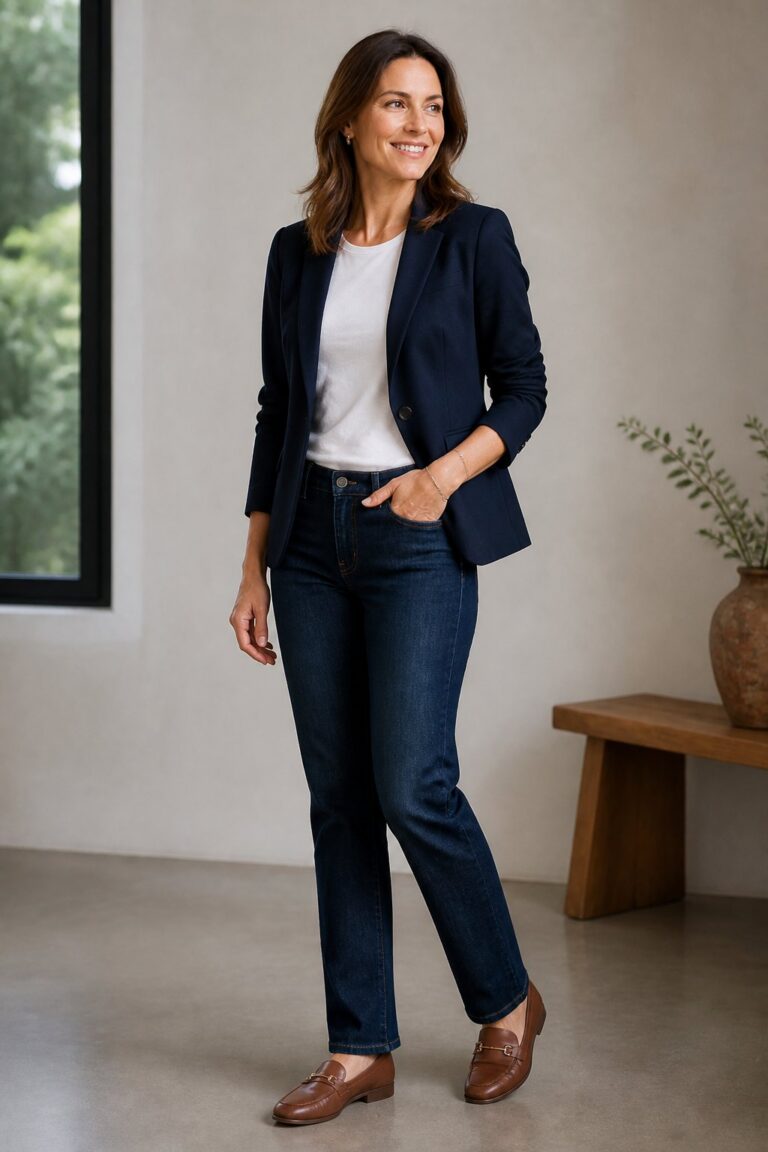
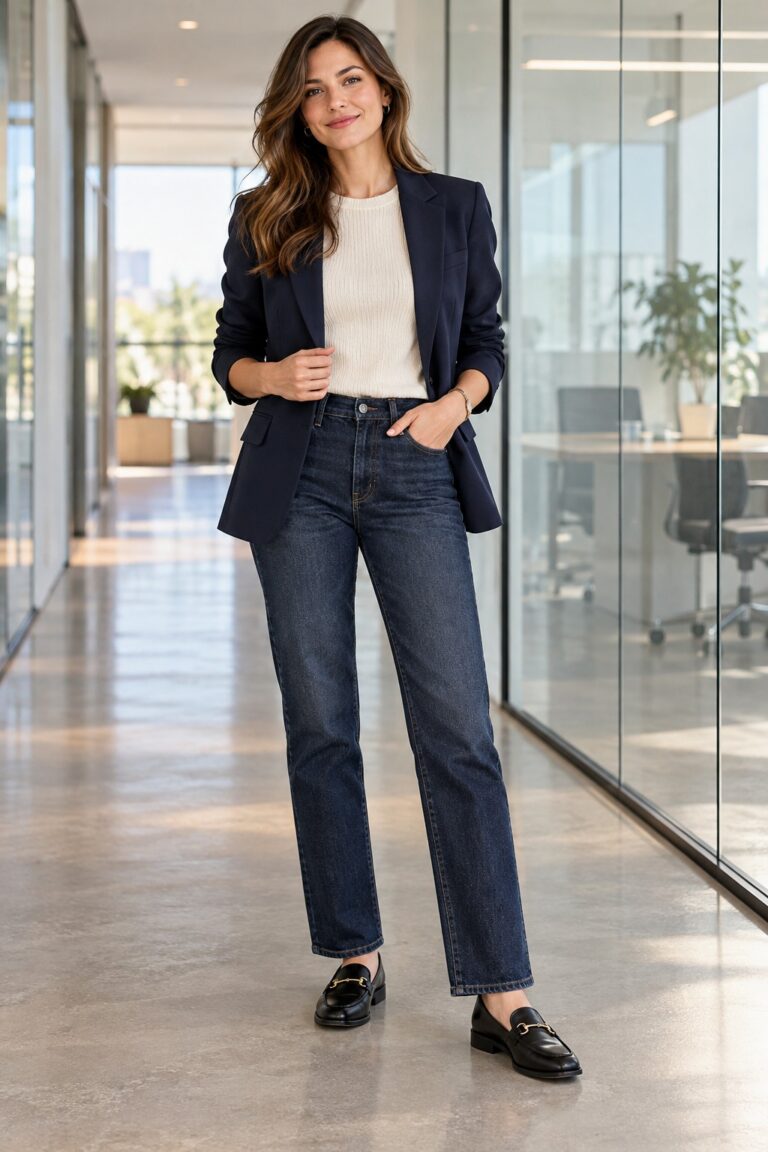
Dark jeans with a white top and camel blazer are one of the most useful boundary examples in this wardrobe.
The blazer is polished.
The top is clean.
The denim is dark and free from distressing.
Yet the jeans still determine whether the outfit works.
In some workplaces this is an ideal business-casual Friday outfit. In others it is simply too casual.
Editorial verdict: CONDITIONAL
The rule is simple:
Do not buy jeans specifically for a business-casual capsule until you know your office actually treats denim as workwear.
If denim is already common around you, dark straight-leg jeans can expand the wardrobe considerably.
If it is not, another trouser will give you far more usable combinations.

Soft blouses and wide trousers belong in the middle
A blue popover blouse with ivory pleated trousers and loafers demonstrates the relaxed side of business casual without relying on denim.
The blouse is softer than a crisp shirt. The trousers have movement. The loafers provide the necessary structure at the bottom.
Editorial verdict: CORE in most modern business-casual offices
This is the kind of outfit that works particularly well when the workplace expects polish but does not expect traditional suiting.
The key is balance.
When one part becomes softer, another part should remain controlled.
Soft blouse + tailored trouser.
Relaxed trouser + polished shoe.
Cardigan + structured pant.
That balance is more useful than memorizing a list of approved garments.

The jumpsuit solves one problem and creates another
A navy tailored jumpsuit with a light cardigan is easy to wear because it eliminates the need to coordinate separates.
That convenience is real.
Its weakness is capsule efficiency.
A blouse may work with five different bottoms. A trouser may work with six tops. A jumpsuit mostly works as itself.
Editorial verdict: CONDITIONAL
Keep one if you genuinely like one-piece dressing.
Do not count it as one of the most productive pieces in a small capsule.
This is a good example of the difference between a good outfit and a good capsule piece.
They are not always the same thing.

When business casual starts becoming corporate
A beige cardigan set with sharply tailored black trousers, pumps, and a structured tote still fits inside the broad business-casual spectrum.
But it sits close to the formal edge.
Change the cardigan to a structured jacket or raise the heel, and the outfit moves further toward corporate dressing.
This boundary is worth recognizing because over-dressing can be almost as uncomfortable as under-dressing.
Editorial verdict: FORMAL EDGE
For a conservative office, this may be an excellent everyday combination.
For a relaxed hybrid workplace, it may feel unnecessarily formal.
The correct answer depends on the room, not on the label printed in an online dress-code guide.

What I would actually build the capsule around
Instead of treating every garment equally, build around three groups.
| Group | Role | Examples |
|---|---|---|
| Reliable core | Works across most business-casual offices | Blouses, button-ups, fine knits, tailored trousers, loafers, low block heels |
| Flexible middle | Adjusts the wardrobe up or down | Blazers, cardigans, shirt dresses, wide-leg trousers, midi skirts |
| Conditional pieces | Depends strongly on workplace culture | Dark denim, culottes, sleeveless shells, jumpsuits, knit sets |
Start with the reliable core.
Add the flexible middle once you understand how formal your workplace feels.
Only then add conditional pieces.
That order prevents one of the biggest capsule mistakes: buying an attractive outfit before confirming that it actually belongs in your working wardrobe.
The fastest way to judge an uncertain outfit
When you are not sure whether something is business casual, look at the whole outfit rather than one garment.
Ask three questions.
1. How many casual signals are present?
Dark denim may work with a blazer and polished shoes.
Dark denim + sneakers + oversized knit + casual tote may cross the line.
2. How many formal signals are present?
A structured blazer + pencil skirt + pumps + formal blouse may technically be acceptable, but the combination may read corporate rather than business casual.
3. Would changing one element fix the balance?
Often the answer is yes.
Sneakers become loafers.
A stiff blazer becomes a cardigan.
High pumps become block heels.
Jeans become trousers.
That one change often matters more than replacing the entire outfit.
The shoe test is surprisingly useful
If you are still unsure where an outfit sits, look at the shoes.
Loafers and low block heels are unusually useful because they sit near the middle of the business-casual spectrum.
High narrow pumps usually push an outfit more formal.
Clean sneakers push it more casual.
Simple flats can move either direction depending on the rest of the outfit.
This is why two people can wear almost identical clothes and still communicate different levels of formality.
Shoes often make the final decision.
Business casual should adapt to the office, not the internet
There is no universal capsule that works equally well in every workplace.
A law office, school administration office, design studio, corporate headquarters, and hybrid technology company may all use the phrase “business casual” while expecting visibly different clothes.
That is why the strongest capsule is not the one containing the most traditionally approved pieces.
It is the one calibrated to the environment where you actually work.
Start slightly more polished when the dress code is unclear.
Watch what colleagues at your level and one level above actually wear.
Then soften the wardrobe only when you know where the boundaries are.
That produces a much more useful capsule than trying to follow a generic checklist.
Plan the next step
If the distinction between business casual and smart casual is still unclear, read Business Casual vs Smart Casual first. That page focuses specifically on where the two dress codes separate.
If you already understand your workplace but need a broader wardrobe system, move to Office Capsule Wardrobe: 15 Pieces I’d Choose for a Real Workweek. Then use the Weekly Outfit Planner to test five combinations before buying anything new. A week of actual outfit planning will reveal wardrobe gaps far more reliably than another shopping list.
Keep these outfit ideas handy.
Save this guide on Pinterest (opens in a new tab)More ideas for your wardrobe
 Work Outfit IdeasSmart Casual Capsule Wardrobe Ideas for Work and Weekend
 Work Outfit IdeasOffice Capsule Wardrobe: 15 Pieces I’d Choose for a Real Workweek
 Work Outfit IdeasCorporate Capsule Wardrobe Ideas for a Polished Office Rotation
 Work Outfit Ideas8 Business Casual Outfits with Jeans for Different Office Dress Codes