
Work Trip Outfits That Take You From Plane To Meeting
Work trips combine several dress codes and kinds of travel in one itinerary. Use this guide as a sample sequence: flight and arrival, conference sessions, client or team dinners, presentation, then return. Move the looks around to match your schedule, and check the weather and venue rules before packing. These are outfit options, not performance guarantees for specific fabrics.
Lay the outfits out in calendar order and identify pieces that can repeat. Count shoes by route and event, not by a fixed limit; a long walk, rain, or a formal venue may change the plan. Pack one practical layer and a backup for the highest-stakes meeting, then remove items that do not solve a real need.
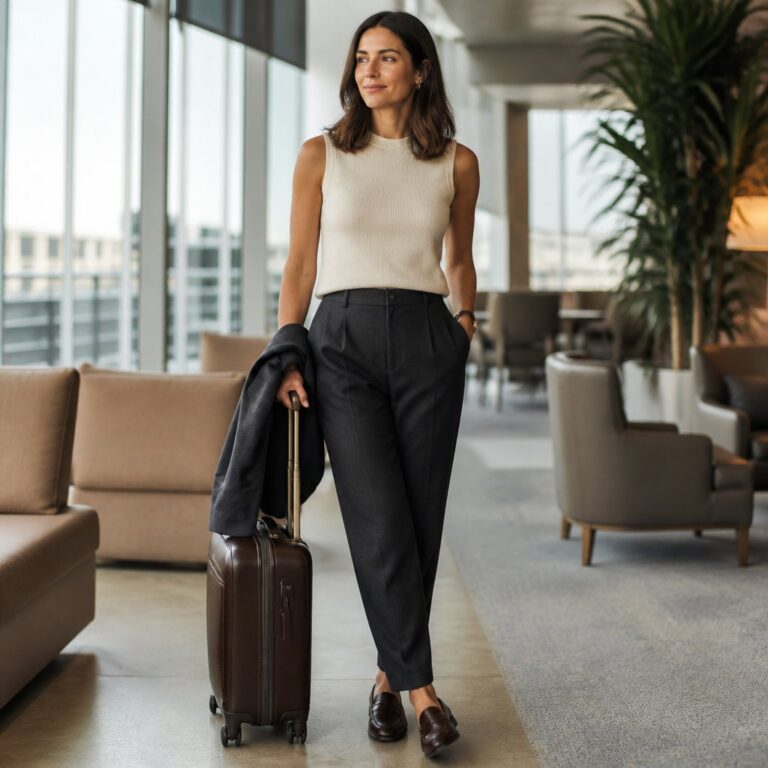
The plane-to-boardroom: ponte trousers, fine-gauge sweater, leather sneakers, blazer in tote

For the flight and arrival, ponte trousers, a fine knit, sneakers, and a blazer in the tote create two levels of formality. Try the trousers seated for the length of a typical flight and check that the blazer fits over the sweater. Keep the airport shoe choice based on your walking and security routine.
When you reach the meeting, add the blazer if the room calls for it. If the outfit needs to be more formal than sneakers allow, pack a shoe that works with another look too. Check the blazer for creasing after it has been folded; pack it differently if the garment’s care label requires it.
The carry-on capsule: black trousers, silk shell, structured blazer, low heels

For a carry-on core, black trousers, a shell, and a blazer can cover more than one meeting slot. Try each piece with a second top or bottom before packing. Check the shell for opacity when worn alone and under the jacket; if you need an extra layer, include it in the packing plan.
Use the trousers with a knit or shirt as well as the shell, and check the dress code for every event. Heels are optional; a polished flat may be easier for long terminal walks. A single-button blazer is not automatically packable, so consider its structure, weight, and care needs.
The conference day one: midi sheath dress, blazer, pointed flats

For conference day one, a midi dress and blazer create one complete outfit without requiring a separate top-and-bottom pairing. Check the neckline, hem, and movement during a full day of sitting and walking between sessions. The blazer can come off indoors if the dress still feels appropriate for the setting.
A pointed flat is one possible conference shoe. If the agenda includes a large venue or long standing sessions, choose footwear you have already tested. Keep the dress in the trip plan only if it can work with a second layer or serve an event where a one-use item is worthwhile.
The conference day two: wide-leg trousers, mock-neck top, block-heel mules

For a second conference day, wide-leg trousers and a mock-neck top change the silhouette while reusing a neutral bottom. Check whether the top feels comfortable at the neck and whether it layers under the jacket. The hem should clear the shoes without catching underfoot.
A closed-toe mule is a dressier choice, but consider how secure it feels on stairs and across a large venue. If it is not practical for the day, use a shoe from another outfit. The point of a second-day look is a planned variation, not a new shoe for every combination.
The client dinner: slip midi, structured blazer, strappy low heels

For a client dinner, choose a dress and layer that fit the venue’s expectations. Check the fabric in the light where it will be worn, and try the full outfit sitting at a table. A blazer can add coverage or warmth, but it should still fit comfortably once you have been in it all day.
A strappy shoe may suit an indoor dinner, but plan the route from transport to the venue and back. If you need more coverage, use a different neckline or layer. Do not assume that a fabric is non-sheer or suitable for conference lighting; inspect the actual garment before packing.
The casual team dinner: cropped trousers, fine-knit top, leather loafers

For a casual team dinner, cropped trousers and a fine-knit top can be less formal than the client-dinner look. Check the team’s usual dress level and the trousers with the shoe you will use. This can reuse a top or shoe from a conference day rather than adding a separate outfit.
Loafers may work for dinner and airport use if they are comfortable for both. Test them before the trip and check the sole for the route. The knit top should be inspected for warmth, care, and layering; fiber content alone does not establish how it feels.
The travel morning: tailored joggers, polished tee, slip-on sneakers

For an early travel morning, tailored joggers and a polished tee create a relaxed base. Check the waistband during a long sit and confirm the joggers are appropriate for any planned work stop. If the outfit needs a sharper layer, choose one that fits over the tee without restricting your arms.
A slip-on sneaker can be convenient for airport routines, but make sure it stays secure while walking. Keep the tee and joggers if they work with another layer in the capsule; otherwise, weigh their comfort against the space they use. A travel outfit still needs to fit the day’s actual plans.
The hotel-room-ready: knit dress, ankle boots, lightweight trench

For a hotel check-in or breakfast meeting, a knit dress and lightweight trench make a simple one-piece option. Try the dress with the coat, then without it, and check that each version suits the setting. The trench is an outer layer only; it does not replace warm clothing for colder conditions.
Ankle boots may work with the dress if the hem and boot shaft sit comfortably together. Check whether the coat folds into the bag you plan to carry and whether its care needs are practical. If the hotel meeting is formal, select a more structured layer or a different base outfit.
The red-eye recovery: long-sleeve tee, ponte pants, court sneakers, hoodie in tote

For a red-eye or overnight flight, choose a tee, trousers, and removable layer that feel comfortable while seated. Check the waistband and sleeves over several hours, and keep a clean top available if you will go directly to a morning meeting. The hoodie is optional; pack only what you can carry easily.
Court sneakers work for some airport routes, but they should already be comfortable and suit the destination. If the meeting calls for more formality, keep the blazer accessible in your tote or plan a quick change. Avoid assuming that ponte pants or any other fabric will resist wrinkles after an overnight flight.
The presentation day: pleated midi, silk shell, low block heels, structured bag

For a presentation, a pleated skirt, shell, and low heel offer a different option from a suit. Check the skirt movement, waistband while seated, and the shell under the room’s lighting. A structured bag can carry notes if it fits the materials you need; it is not required for the outfit to look professional.
If the presentation has a formal dress code, add a jacket that works with other outfits. Rehearse standing and walking in the complete look before travel day. If the pleated skirt is a one-event piece, decide whether its role is worth the bag space compared with a bottom you can repeat.
Plan the next step
Before departure, use a one-page itinerary: event, outfit, shared pieces, outer layer, and shoe. Check each combination against the venue, forecast, and care needs; keep one backup for schedule changes. After packing, make sure the first-day outfit is easy to reach rather than buried under everything else.
For other trip types, see travel outfit ideas and business casual travel outfits. The travel outfits for women hub covers broader trip needs; the work capsule wardrobe ideas and business casual vs smart casual guides cover the workwear foundation.
Keep these outfit ideas handy.
Save this guide on Pinterest (opens in a new tab)More ideas for your wardrobe
 Travel Outfit IdeasWork Travel Outfits That Transition From the Flight to the Meeting
 Travel Outfit IdeasBusiness Casual Travel Outfits for Women Who Need Plane-to-Meeting Polish
 Travel Outfit IdeasVacation Capsule Wardrobe: Pack Light Without Leaving Anything Behind
 Travel Outfit IdeasTravel Outfit Formulas: Packable Looks for Trips Without Overpacking