
Office Capsule Wardrobe: 15 Pieces I’d Choose for a Real Workweek
Most office capsule wardrobes make the same mistake: they focus on reaching a certain number of clothes instead of asking whether those clothes actually work together.
A 15-piece wardrobe is not useful if five pieces only work in one outfit. And a closet is not really a capsule if every new combination requires another shoe, another jacket, or another special-purpose top.
If I were building an office capsule from scratch, I would judge every piece by three questions: How many other pieces does it work with? Can it move between more than one level of formality? And would I realistically reach for it during an ordinary workweek?
Using that filter, these are the 15 garments I would keep.
The 15-piece office capsule
| Piece | Why it earns a place |
|---|---|
| Navy blazer | The main structure piece. Works with trousers, skirt, dress, tee, blouse, and knits. |
| Cream fine-gauge cardigan | Handles softer office days without duplicating the blazer. |
| Ivory blouse | Works with every bottom in the capsule and both layers. |
| White button-up | Gives the wardrobe a sharper option for meetings and presentations. |
| Black-and-white striped tee | Adds one controlled casual piece without turning the capsule into weekend wear. |
| Beige fine-knit top | A warmer neutral that works especially well with olive, black, navy, grey, and camel. |
| Black fine-knit top | The easiest cold-weather and high-contrast base. |
| Pale pink blouse | Adds color while still behaving like a neutral beside navy, grey, camel, and black. |
| Grey straight-leg trousers | The most versatile everyday trouser. |
| Black ankle trousers | Useful when the outfit needs to feel clean and slightly sharper. |
| Grey wide-leg trousers | Gives the capsule a different silhouette without introducing a difficult color. |
| Olive trousers | Adds color without reducing outfit compatibility. |
| Camel trousers | Warm alternative to grey and black, particularly useful in cooler months. |
| Navy pencil skirt | The only skirt I would include initially because it fills a role the trousers cannot. |
| Navy sheath dress | The low-decision option for meetings, presentations, and mornings when separates feel like work. |
Shoes, bags, jewelry, belts, and outerwear are deliberately not included in the 15. Counting a belt as one of your capsule pieces may make the number look tidy, but it does not make getting dressed easier.
The anchor outfit tells you whether the capsule works

Start with the navy blazer, ivory blouse, and grey straight-leg trousers.
This combination matters because all three pieces have to survive outside this exact outfit.
The blazer should work over the striped tee, black knit, pale pink blouse, sheath dress, and white shirt. The grey trousers should work with almost every top. The ivory blouse should work with every trouser, the skirt, and both layers.
That is what makes them capsule pieces rather than simply a good outfit.
If an expensive blazer only works with the trousers you bought beside it, it is not an anchor. It is a matching set.
The cardigan should do a different job from the blazer

A capsule does not need two layers that solve the same problem.
The cream cardigan earns its place because it deliberately lowers the formality of the wardrobe. Pair it with black ankle trousers and an ivory blouse and the outfit still reads as office-appropriate, but softer than the blazer formula.
This is useful for desk-heavy days, internal meetings, hybrid schedules, and offices where wearing tailoring every day would feel overdressed.
I would choose a fine-gauge cardigan rather than a chunky one. It layers more cleanly, occupies less visual space, and works with skirts and dresses as easily as trousers.
Wide-leg trousers earn a place only because they change the silhouette

Grey straight-leg trousers and grey wide-leg trousers may sound repetitive.
I would still keep both.
The reason is shape rather than color. The straight-leg pair handles ordinary office days. The wide-leg pair creates a stronger line for presentations, dinners after work, and outfits where a simple white shirt needs more presence.
A second pair of nearly identical straight trousers would add inventory. A genuinely different silhouette adds options.
That is an important distinction when deciding whether something belongs in a small wardrobe.
One patterned top is enough

I would not build a 15-piece work capsule around several prints.
The striped tee gets one slot because it makes a blazer-and-trouser combination feel less formal without making it less intentional.
That gives the wardrobe a casual Friday option and works well in workplaces where a plain tee would feel unfinished.
But once that role is filled, I would stop.
A floral blouse, checked shirt, printed skirt, and striped knit may all look appealing separately, but they reduce the number of easy combinations. In a small capsule, solid colors should do most of the work.
Olive is the color piece I would keep

If every trouser is black, navy, or grey, the wardrobe becomes efficient but visually flat.
Olive solves that without behaving like a difficult accent color.
It works naturally with beige, ivory, white, black, navy, and many shades of grey. That gives it far more mixing power than a brighter statement trouser.
This is where I would use color in a small office capsule: on a piece that still behaves like a neutral.
The sheath dress is here because some mornings need one decision

A capsule made entirely from separates looks efficient on paper but ignores how people actually get dressed.
There are mornings when choosing a top, bottom, layer, tuck, belt, and proportion is more effort than you want to spend.
That is why I would keep one navy sheath dress.
It can stand alone, take the blazer when the day needs more authority, or take the cardigan when the office is less formal.
One dress gives the capsule a different way of functioning, not merely another outfit.
The pencil skirt has to justify itself against six trousers

A navy pencil skirt only deserves a place if you actually wear skirts.
I would not include it simply because capsule lists traditionally contain one.
Its argument for inclusion is that it changes the silhouette substantially while still working with the ivory blouse, white shirt, beige knit, black knit, pale pink blouse, cardigan, and blazer.
If skirts consistently sit untouched in your real wardrobe, this is the first piece I would replace.
A capsule should reflect behavior, not complete a checklist.
What I would leave out

This is where capsule advice becomes more useful than another shopping list.
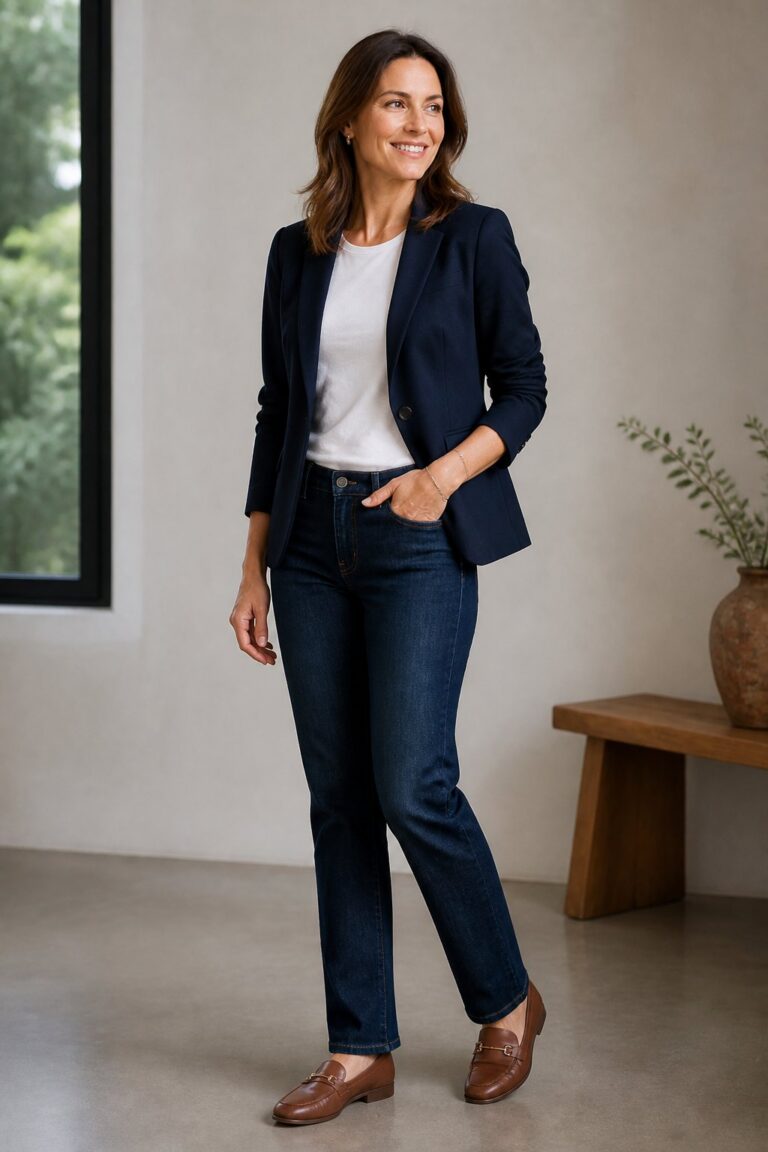
I would not put dark jeans into the core 15 unless the workplace clearly allows them. Jeans are useful, but they narrow the capsule toward casual offices. They are better treated as an extension piece once you know your dress code.
I would also skip a second long cardigan. One soft layer is enough at this size.

And despite looking polished, I would not use one of the original 15 slots on a black jumpsuit.
A jumpsuit can make a great outfit, but it does relatively little mixing. A blouse can create six or seven combinations. A trouser can create another six or seven. A jumpsuit mostly creates variations of itself.
That does not make it a bad purchase. It makes it a weaker capsule purchase.
Office capsule vs corporate capsule
These are not the same wardrobe.
For a normal business-casual office, I would keep the striped tee, cardigan, olive trousers, and wider range of softer combinations.
For a conservative corporate environment, I would change the balance rather than simply buying more clothes. The striped tee would probably go. A second structured jacket might enter. Closed-toe footwear becomes more important, and the white shirt, sheath dress, blazer, straight trousers, and pencil skirt carry more of the week.
For a smart-casual office, I would move in the opposite direction. Dark denim could replace the pencil skirt or one pair of trousers, and clean sneakers might become part of the regular rotation.
The best capsule is not the one with the most universally approved pieces. It is the one that matches the actual formality of the room you walk into every morning.
Eight realistic workday formulas
| Workday | Combination |
|---|---|
| Regular meeting day | Ivory blouse + grey straight trousers + navy blazer |
| Desk-heavy day | Ivory blouse + black ankle trousers + cream cardigan |
| Presentation | White button-up + grey wide-leg trousers + navy blazer |
| Casual Friday | Striped tee + black ankle trousers + navy blazer |
| Relaxed internal day | Beige knit + olive trousers + cream cardigan |
| Client lunch | Pale pink blouse + navy pencil skirt + navy blazer |
| Cold-weather office day | Black knit + camel trousers + navy blazer |
| Low-decision morning | Navy sheath dress + cream cardigan or blazer |

The usefulness of the 15 pieces becomes clearer when they solve different types of days.
Notice that these are not eight isolated outfits.
The same blazer appears repeatedly. So do the same trousers, tops, and layers.
That repetition is the point.
A capsule succeeds when repeating clothes becomes easier than buying another outfit.
The three-outfit rule I would use before buying anything else
Once the 15-piece foundation is built, every potential purchase gets one simple test.
Before buying it, name three outfits you can make with pieces already in the capsule.
Not three imaginary future outfits.
Three outfits using clothes already in your closet.
If you cannot do that quickly, the new item probably creates another problem instead of solving one.
This rule is especially useful with statement blouses, unusual trouser colors, difficult skirts, and jackets bought because they looked impressive on their own.
A capsule wardrobe improves when every addition increases the usefulness of what you already own.
Plan the next step
If your main problem is deciding what counts as office-appropriate in the first place, use the Business Casual vs Smart Casual guide before changing your wardrobe. The dress-code decision should come before the shopping decision.
If you already own most of these pieces, move to the Weekly Outfit Planner and build five actual workdays from what you have. That exercise will show you whether the missing piece is really another garment, or simply a better way to combine the clothes already in your closet.
Keep these outfit ideas handy.
Save this guide on Pinterest (opens in a new tab)More ideas for your wardrobe
 Work Outfit IdeasCorporate Capsule Wardrobe Ideas for a Polished Office Rotation
 Work Outfit IdeasBusiness Casual Capsule Wardrobe: What Belongs, What Doesn’t, and Why
 Work Outfit IdeasSmart Casual Capsule Wardrobe Ideas for Work and Weekend
 Work Outfit IdeasWorkwear Capsule Wardrobe Ideas for Repeatable Weekday Outfits